
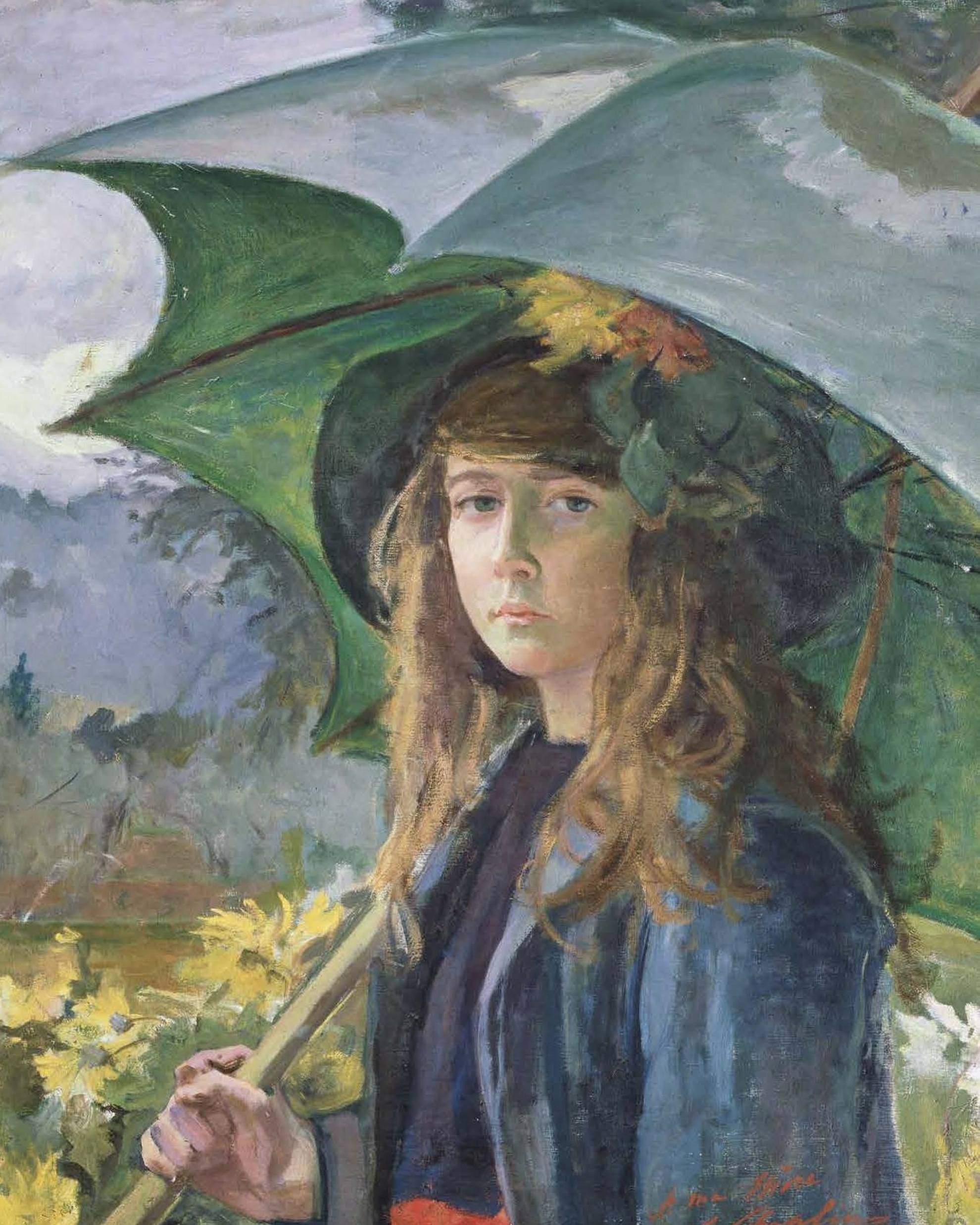
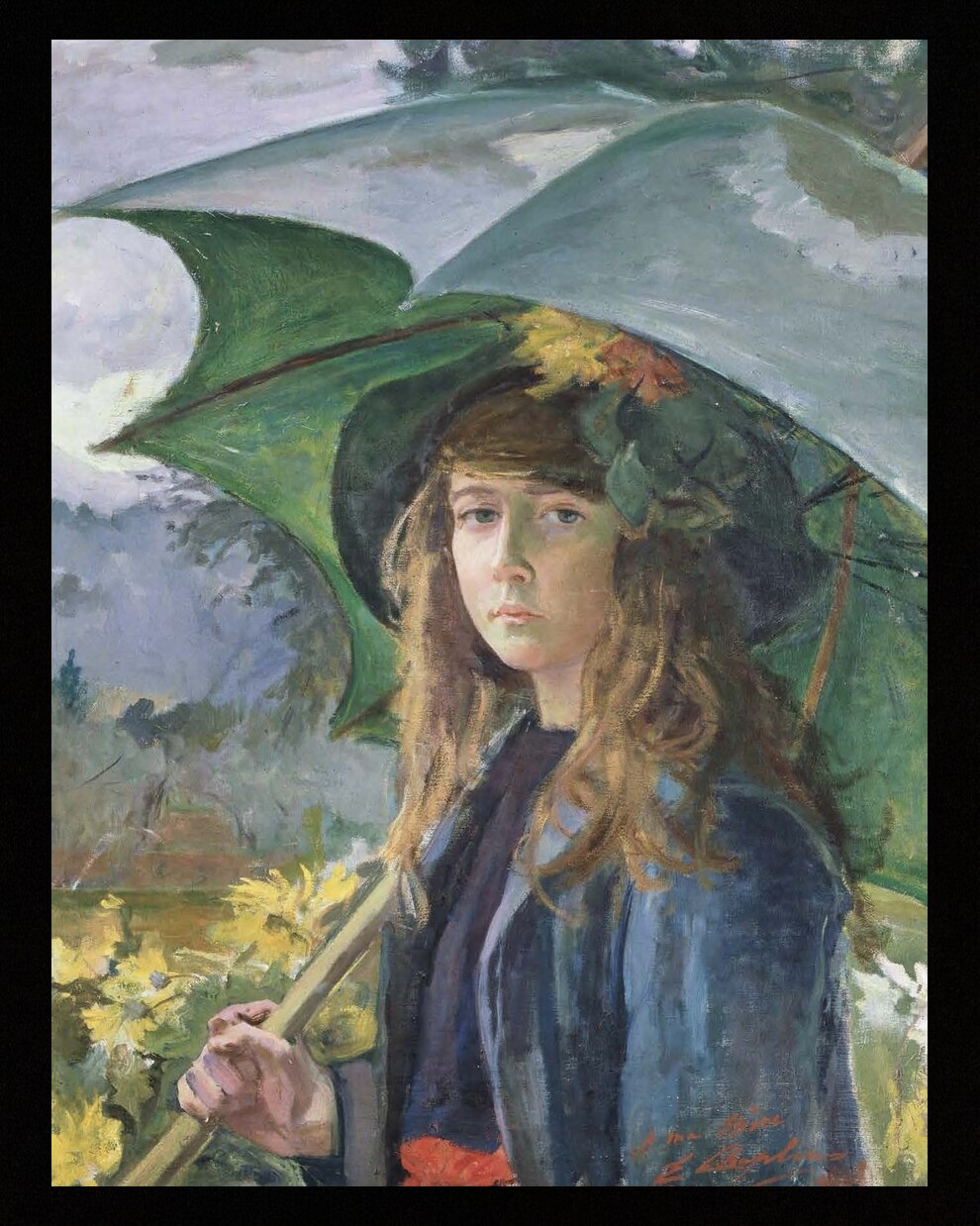
In the late 1970s, a visitor to Palazzo Pitti’s Gallery of Modern Art hurrying for an appointment with the then-director, Sandra Pinto, would have been astonished to come face-to-face with an exquisite and stunning portrait of a charming young girl beneath a green umbrella. I say astonished because Pinto, a savvy and enterprising functionary in the ranks of the city’s Superintendency for Art, had notoriously cut her teeth on the teachings of Giulio Carlo Argan, who was a proponent of Abstraction. In her time at the National Gallery of Modern Art in Rome, moreover, Pinto had been a capable and devoted colleague to the revolutionary art historian Palma Bucarelli, who had initiated her into a fervid appreciation for the most advanced contemporary art.
The bust-length self-portrait, held since 1946 in the Uffizi’s Gallery of Self-Portraits, was the work of a young French artist, Élisabeth Chaplin (1890-1982), born at Fontainebleau, but later raised by her parents in the hills of Fiesole, and it did not align with such affinities at all. It was painted by Chaplin at the youthful age of fourteen and clearly shows a departure from the Impressionist style. If anything, it exhibits a soft, delicate approach to the use of line that can be traced back to the earlier Pre-Raphaelite movement.
Élisabeth Chaplin was born into a highly educated, aristocratic family which could be described as both intellectual and eccentric. Her father William was an engineer and a military man. A staunch Dreyfusard, he was the son of the artist Charles Joshua Chaplin (1825-1891), a Jewish painter born to a French mother and an English father. And so Élisabeth could look to a paternal grandfather who was admired and appreciated by the French aristocracy for a style that recalled the sweetness and soft lines of Greuze and Boucher. Her uncle, Arthur (William’s brother), was a painter like his father. Her mother, Marguerite de Bavier-Chauffour, was an eminent poetess, sculptor, fine photographer, and an aficionado of the occult, as well as a close friend of such Symbolist artists as Maurice Denis. She was a descendent of a noble and wealthy Alsatian clan that included prominent industrialists, politicians, and soldiers, as well as, most notably, Charlotte Buff-Kestner. Charlotte Buff had been a close friend of the young Goethe, who had asked for her hand in marriage. She spurned him, however, and married Johann Christian Kestner. Goethe would later immortalize her in his Sorrows of Young Werther. In the aftermath of the Dreyfus affair, William chose to leave not only the French army but France itself, and moved to Italy with his family, stopping first at Bagnasco (Piedmont), then at Laigueglia (Liguria). After a brief stay in Florence, enchanted by the city’s beauty and the picturesque, Virgilian landscape of its surrounding hills, the family chose to settle there.
The bust-length self-portrait, held since 1946 in the Uffizi’s Gallery of Self-Portraits, was the work of a young French artist, Élisabeth Chaplin (1890-1982), born at Fontainebleau, but later raised by her parents in the hills of Fiesole, and it did not align with such affinities at all. It was painted by Chaplin at the youthful age of fourteen and clearly shows a departure from the Impressionist style. If anything, it exhibits a soft, delicate approach to the use of line that can be traced back to the earlier Pre-Raphaelite movement.
Élisabeth Chaplin was born into a highly educated, aristocratic family which could be described as both intellectual and eccentric. Her father William was an engineer and a military man. A staunch Dreyfusard, he was the son of the artist Charles Joshua Chaplin (1825-1891), a Jewish painter born to a French mother and an English father. And so Élisabeth could look to a paternal grandfather who was admired and appreciated by the French aristocracy for a style that recalled the sweetness and soft lines of Greuze and Boucher. Her uncle, Arthur (William’s brother), was a painter like his father. Her mother, Marguerite de Bavier-Chauffour, was an eminent poetess, sculptor, fine photographer, and an aficionado of the occult, as well as a close friend of such Symbolist artists as Maurice Denis. She was a descendent of a noble and wealthy Alsatian clan that included prominent industrialists, politicians, and soldiers, as well as, most notably, Charlotte Buff-Kestner. Charlotte Buff had been a close friend of the young Goethe, who had asked for her hand in marriage. She spurned him, however, and married Johann Christian Kestner. Goethe would later immortalize her in his Sorrows of Young Werther. In the aftermath of the Dreyfus affair, William chose to leave not only the French army but France itself, and moved to Italy with his family, stopping first at Bagnasco (Piedmont), then at Laigueglia (Liguria). After a brief stay in Florence, enchanted by the city’s beauty and the picturesque, Virgilian landscape of its surrounding hills, the family chose to settle there.
They first took up residence at Villa Rossi, near Villa La Pietra, renowned home of the Actons, and later moved to Villa Levi. By then Marguerite and William had separated, and in 1906 a governess, Ida Capecchi, who was a respected and educated pupil of Edmondo De Amicis as well as a skilled administrator, was hired to educate the children. Marguerite turned to Ida for help in finding a larger house with a garden. She soon purchased the villa Il Treppiede in Via di Barbacane in San Domenico di Fiesole from an interesting and aristocratic English world traveler. In renovating it, Marguerite raised it by a story, creating a view not towards the city of Florence but towards Monte Ceceri and the town of Fiesole.
In an interview with art historian Luciano Berti, published in Paragone in March 1978, Élisabeth, then almost ninety, recalls her early years:
“I started painting at the age of ten, when I was given a box of paints... I was surrounded by greenery and nature, though I was almost exclusively interested at that age, as a painter, in the human figure. And there were the delightful locals... I loved the way they gesticulated, their lovely way... Very simply, Florence filled me with joy. Of the Italian masters, I admired above all Giotto and Donatello; Giotto remains unrivalled, and I like Donatello even better than the other great artist who came later... though I’m less fond of him... Michelangelo... no, I prefer Donatello... great master that he was... as well as a scientist... you know, the one who studied everything, even the flight of birds... now the name escapes me... Ah, that’s right! Leonardo...” In her account, the artist forgets to mention Botticelli, a painter she dearly loved, whose Madonna of the Pomegranate (Uffizi) she had copied. In her preference for figurative painting, Élisabeth shared the tastes of a distinguished yet very different fellow painter: Henri Matisse. In 1914 Matisse wrote:
“What interests me most is neither still life nor landscape, but the human figure. It is that which best permits me to express my almost religious awe towards life. […] When I see the Giotto frescoes at Padua I do not trouble myself to recognize which scene of the life of Christ I have before me, but I immediately understand the sentiment which emerges from it, for it is in the lines, the composition, the color.”
Élisabeth showed little interest in the new developments of avant-garde art, nor was she attracted by the intellectual simplicity of the inventions of the Macchiaioli and the Post-Macchiaioli, despite a brief acquaintance with Francesco Gioli and a fleeting encounter with Giovanni Fattori.
In the first decade of the twentieth century, Florence and its surroundings were a fervent outpost for new advances in culture and art. Gabriele D’Annunzio at La Capponcina, Arnold Böcklin at Villa Bellagio, Max Klinger at Villa Romana, and Bernard Berenson at Villa I Tatti attracted writers, artists, scholars, and collectors from all over the world. Magazines and journals treating literature and art sprang up – La Voce, Il Leonardo, Lacerba, etc. The longest-lived publication (which only ceased in 1932) was Il Marzocco, founded and run by Angiolo and Adolfo Orvieto, with contributors such as D’Annunzio and Pascoli.
In an interview with art historian Luciano Berti, published in Paragone in March 1978, Élisabeth, then almost ninety, recalls her early years:
“I started painting at the age of ten, when I was given a box of paints... I was surrounded by greenery and nature, though I was almost exclusively interested at that age, as a painter, in the human figure. And there were the delightful locals... I loved the way they gesticulated, their lovely way... Very simply, Florence filled me with joy. Of the Italian masters, I admired above all Giotto and Donatello; Giotto remains unrivalled, and I like Donatello even better than the other great artist who came later... though I’m less fond of him... Michelangelo... no, I prefer Donatello... great master that he was... as well as a scientist... you know, the one who studied everything, even the flight of birds... now the name escapes me... Ah, that’s right! Leonardo...” In her account, the artist forgets to mention Botticelli, a painter she dearly loved, whose Madonna of the Pomegranate (Uffizi) she had copied. In her preference for figurative painting, Élisabeth shared the tastes of a distinguished yet very different fellow painter: Henri Matisse. In 1914 Matisse wrote:
“What interests me most is neither still life nor landscape, but the human figure. It is that which best permits me to express my almost religious awe towards life. […] When I see the Giotto frescoes at Padua I do not trouble myself to recognize which scene of the life of Christ I have before me, but I immediately understand the sentiment which emerges from it, for it is in the lines, the composition, the color.”
Élisabeth showed little interest in the new developments of avant-garde art, nor was she attracted by the intellectual simplicity of the inventions of the Macchiaioli and the Post-Macchiaioli, despite a brief acquaintance with Francesco Gioli and a fleeting encounter with Giovanni Fattori.
In the first decade of the twentieth century, Florence and its surroundings were a fervent outpost for new advances in culture and art. Gabriele D’Annunzio at La Capponcina, Arnold Böcklin at Villa Bellagio, Max Klinger at Villa Romana, and Bernard Berenson at Villa I Tatti attracted writers, artists, scholars, and collectors from all over the world. Magazines and journals treating literature and art sprang up – La Voce, Il Leonardo, Lacerba, etc. The longest-lived publication (which only ceased in 1932) was Il Marzocco, founded and run by Angiolo and Adolfo Orvieto, with contributors such as D’Annunzio and Pascoli.
Other prominent individuals operated in the literary and artistic fields: Giovanni Papini, Ardengo Soffici, Ugo Ojetti, Antonio Maraini, the writer and playwright Amelia Rosselli (mother of Carlo and Nello, whose murders in France were ordered by Mussolini), and Edward Gordon Craig. Marguerite Chauffour established friendships at that time that would last a lifetime: with Angiolo Orvieto and his wife Laura Cantoni (also a writer), with Amelia Rosselli, and with the Olschkis.
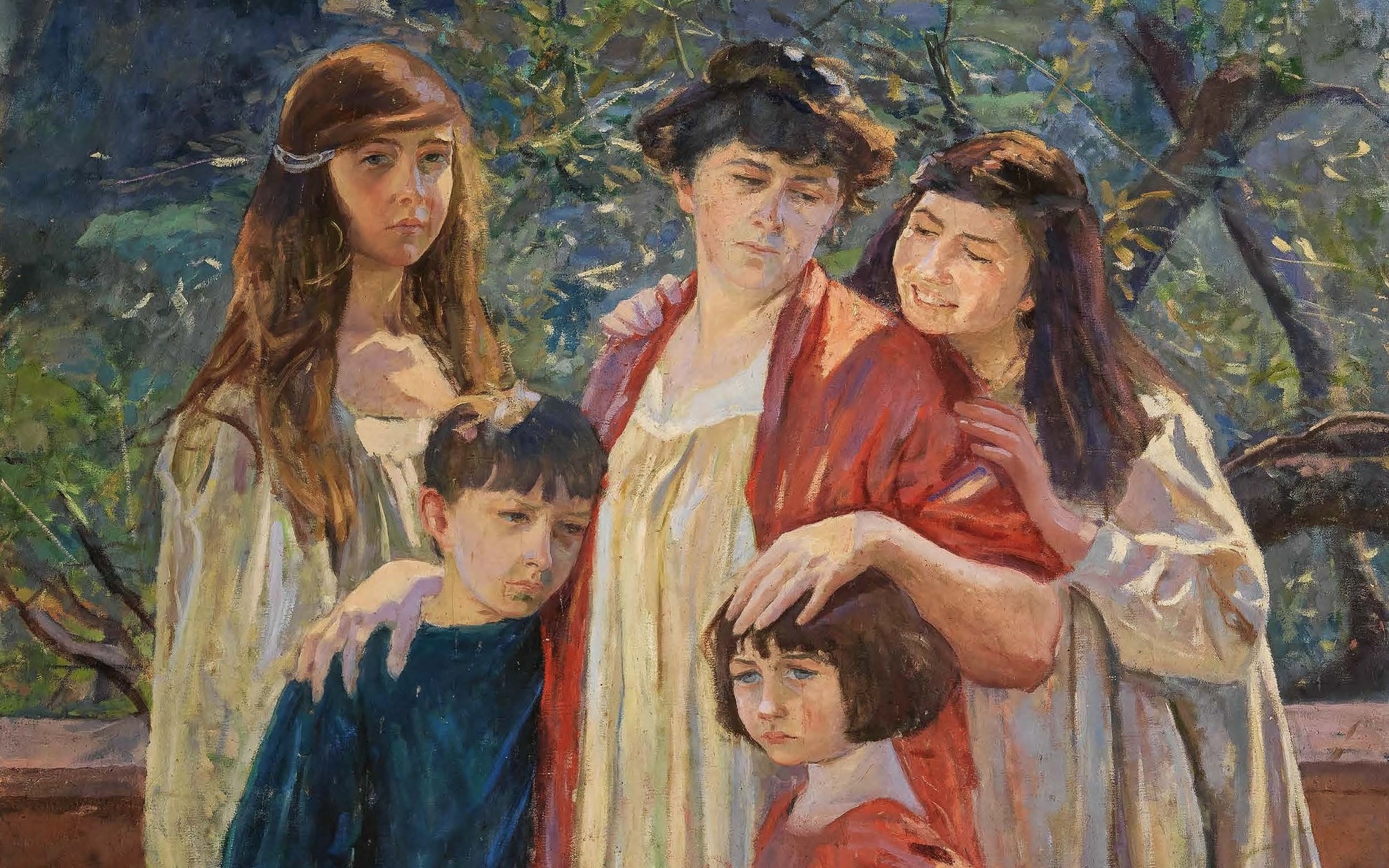
While still staying at Villa Rossi, Élisabeth painted one of her most beautiful paintings, Family Portrait, Outdoors. It is a large canvas, practically an altarpiece, in which a kind of sixteenth-century sculptural presence is combined with the soft, sinuous lines of the Pre-Raphaelites. Chaplin here shows her love of oversized, almost monumental paintings. The background features the understated, busy countryside of Fiesole; in the foreground are mother and children. Marguerite stands, gently lost in thought, while Yvette fondly smiles, resting her chin on her mother’s shoulder; Nenette and Jean-Jacques turn their heads with furrowed brows. Élisabeth, in keeping with the practice of the self-portrait, paints herself as serious and attentive.
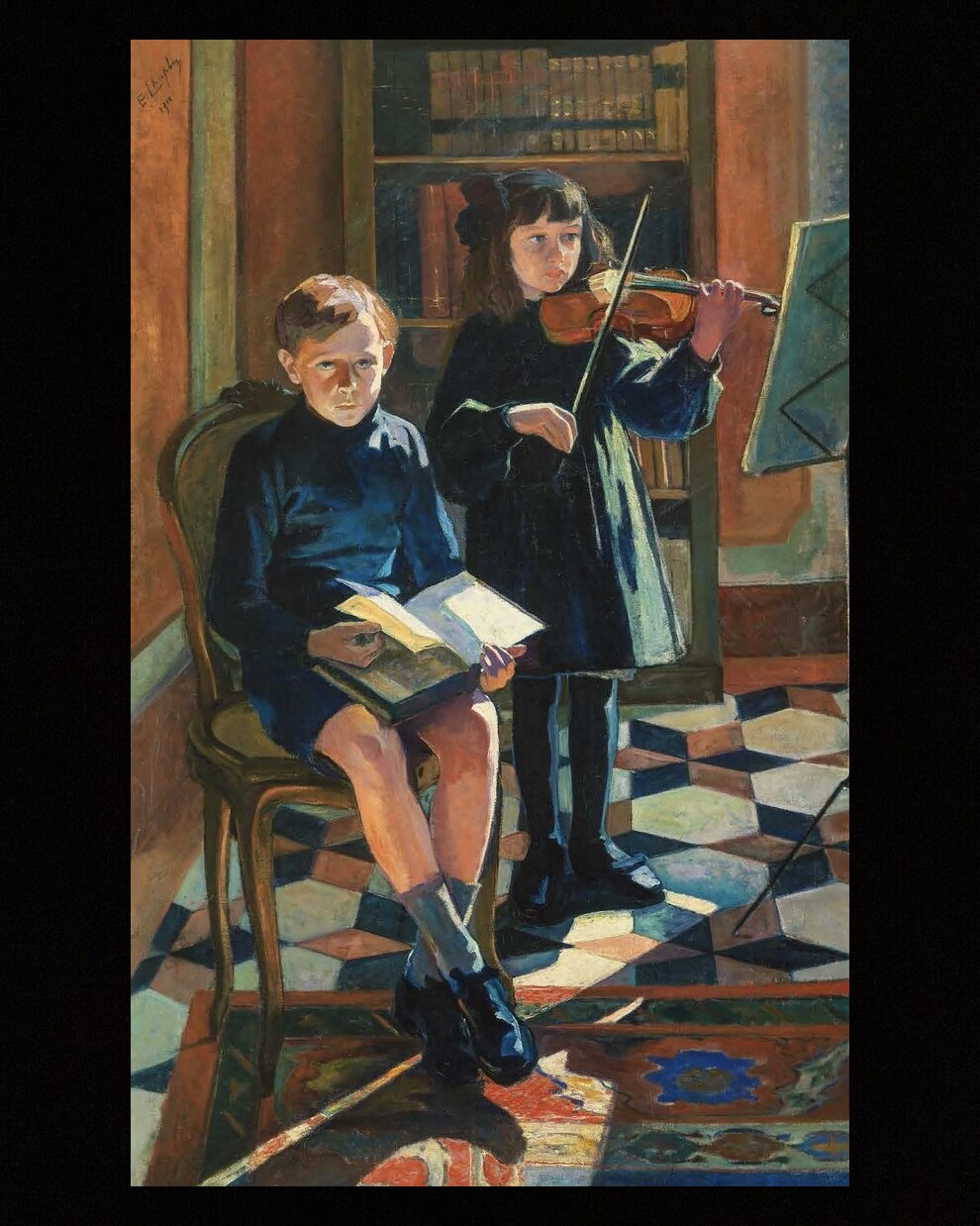
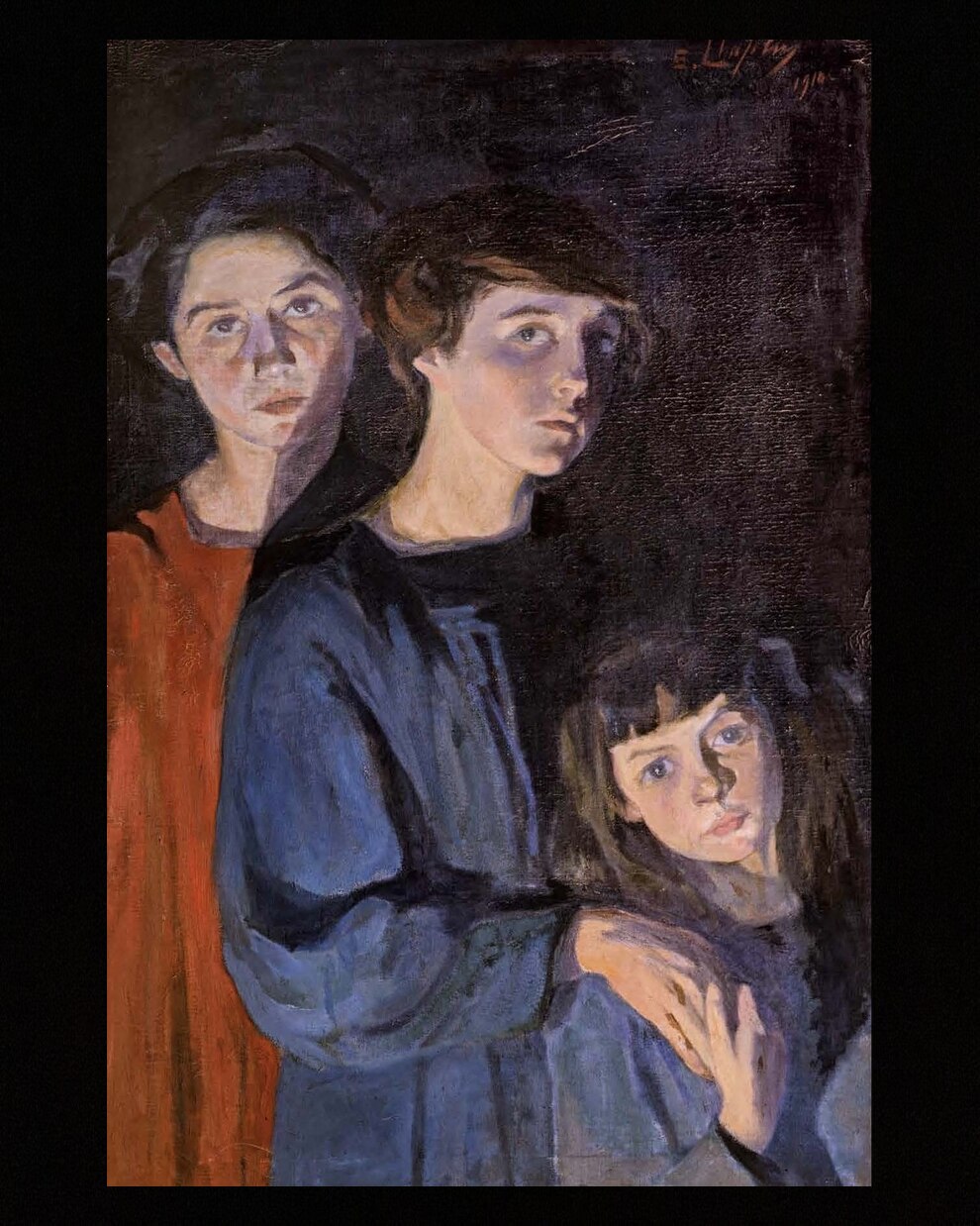
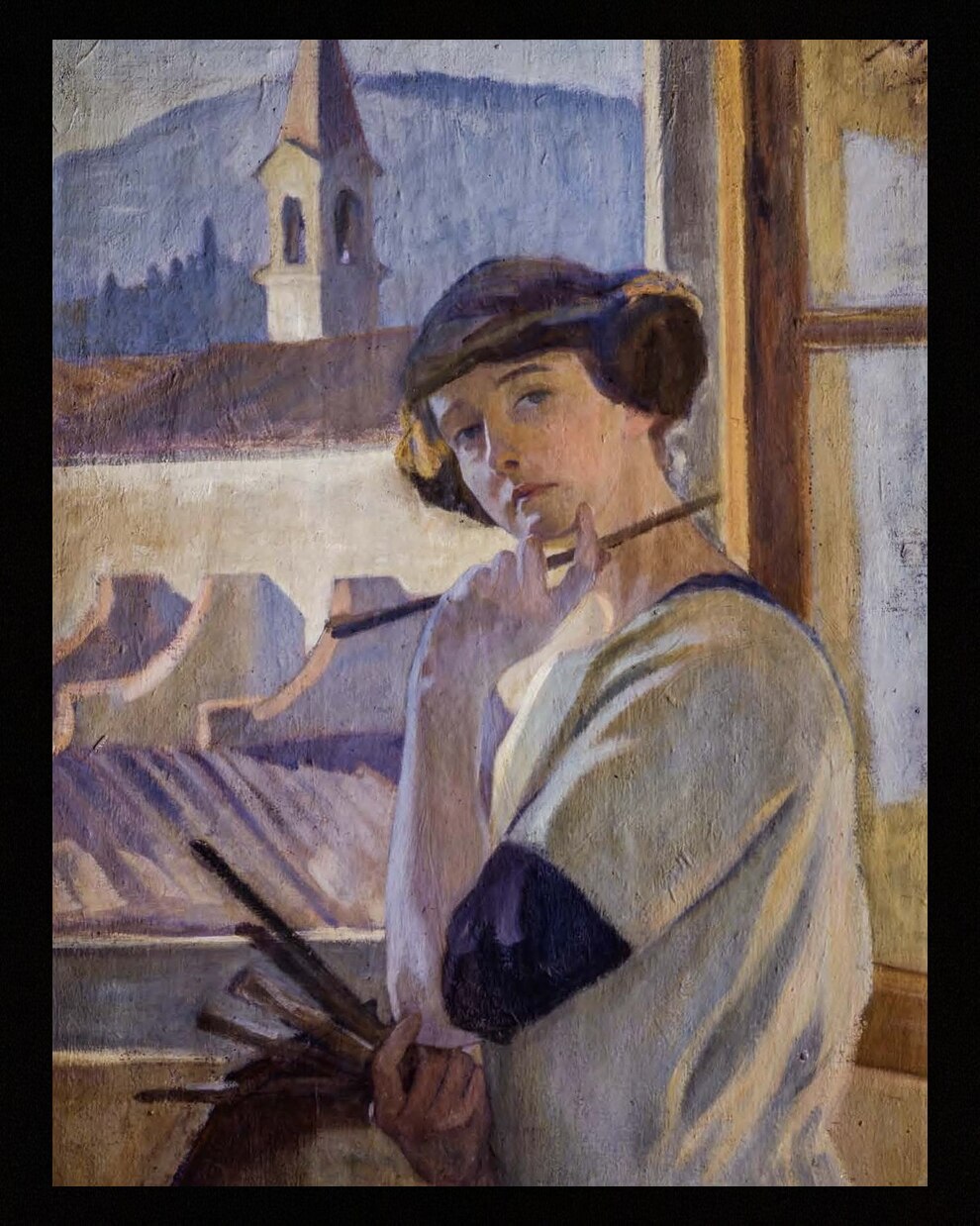
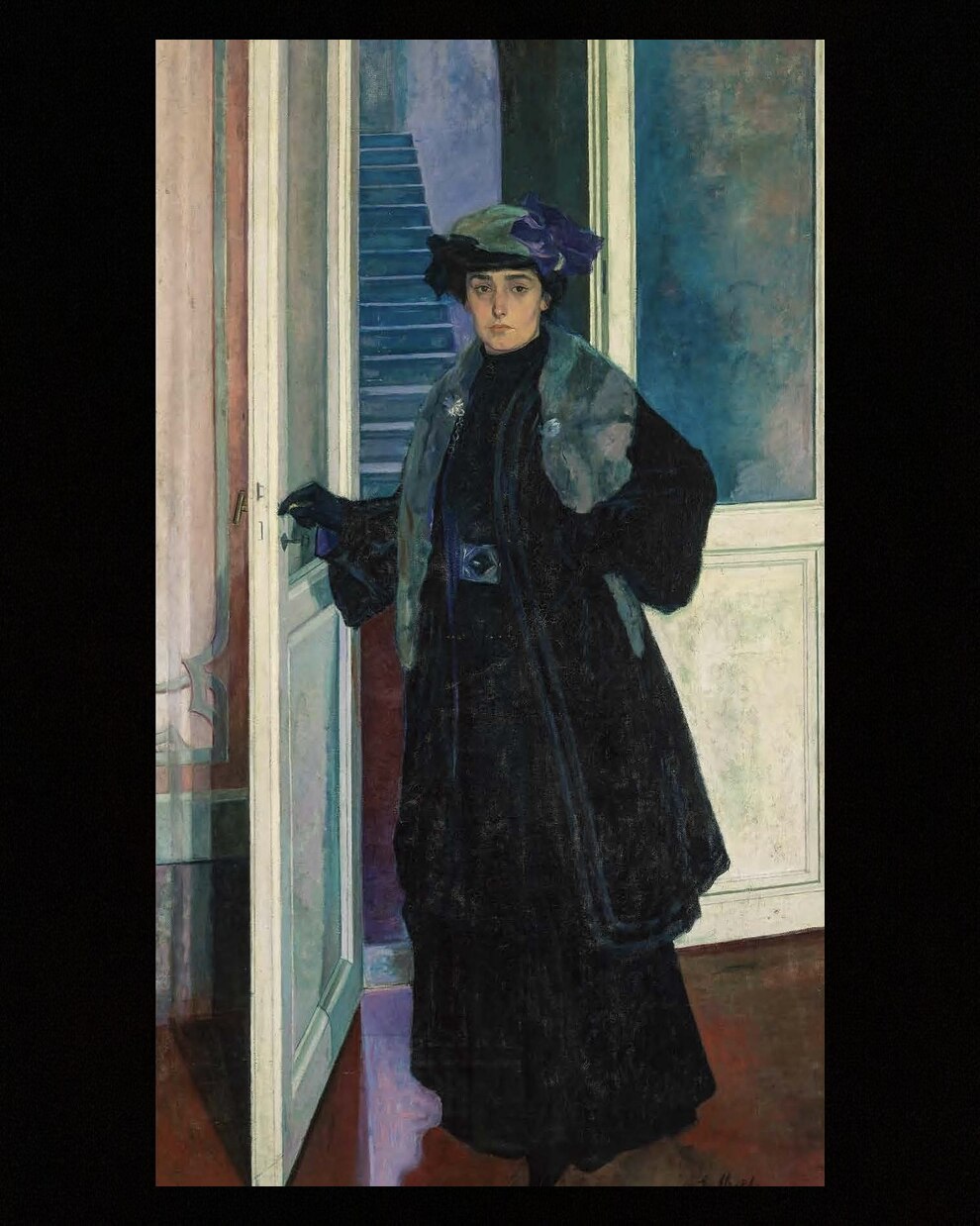
In Study Hour, painted at Villa Levi and exhibited in 1911 at Rome’s International Exposition of Valle Giulia, the two young protagonists are arranged along a diagonal axis that bisects the brightly lit room: a raking ray of light envelops them, highlighting their static volume and willfully serious pose. The painting entitled Three Sisters, likewise done at Villa Levi, conveys a state of uneasiness through almost cinematic sidelighting; the girls’ features emerge almost spectrally from the dark background, heightening the anxiety and agitation. Shortly thereafter, Yvette left both home and family, settling in Denmark with her boyfriend. Yet again at Villa Levi, in 1910, Élisabeth painted an elegant Self-Portrait By the Window. This is a skillful study of light and a meticulous compositional study in which intersecting planes create complex geometries. The subdued and almost imperceptible design calls out the figure, who is demurely dressed in soft ranges of gray. The pose is coquettish and the emblems of her identity as an artist are prominent. In the background the bell tower of a church that cuts across the landscape has the feel of a concise vision and evokes the Trecento. Portrait of Ida at the Bottom of the Stairs, likewise from 1910, reveals the artist’s debt to nineteenth-century French painting in the strong architectural setting, the subject’s bold appearance, and the dark hues of the dress with blacks that recall Daumier. Family Portrait, Indoors (1910) is the last painting done at Villa Levi. It is reminiscent of group and family portraits typical of seventeenth-century Dutch painting.
While still staying at Villa Rossi, Élisabeth painted one of her most beautiful paintings, Family Portrait, Outdoors. It is a large canvas, practically an altarpiece, in which a kind of sixteenth-century sculptural presence is combined with the soft, sinuous lines of the Pre-Raphaelites. Chaplin here shows her love of oversized, almost monumental paintings. The background features the understated, busy countryside of Fiesole; in the foreground are mother and children. Marguerite stands, gently lost in thought, while Yvette fondly smiles, resting her chin on her mother’s shoulder; Nenette and Jean-Jacques turn their heads with furrowed brows. Élisabeth, in keeping with the practice of the self-portrait, paints herself as serious and attentive.
In Study Hour, painted at Villa Levi and exhibited in 1911 at Rome’s International Exposition of Valle Giulia, the two young protagonists are arranged along a diagonal axis that bisects the brightly lit room: a raking ray of light envelops them, highlighting their static volume and willfully serious pose. The painting entitled Three Sisters, likewise done at Villa Levi, conveys a state of uneasiness through almost cinematic sidelighting; the girls’ features emerge almost spectrally from the dark background, heightening the anxiety and agitation. Shortly thereafter, Yvette left both home and family, settling in Denmark with her boyfriend. Yet again at Villa Levi, in 1910, Élisabeth painted an elegant Self-Portrait By the Window. This is a skillful study of light and a meticulous compositional study in which intersecting planes create complex geometries. The subdued and almost imperceptible design calls out the figure, who is demurely dressed in soft ranges of gray. The pose is coquettish and the emblems of her identity as an artist are prominent. In the background the bell tower of a church that cuts across the landscape has the feel of a concise vision and evokes the Trecento. Portrait of Ida at the Bottom of the Stairs, likewise from 1910, reveals the artist’s debt to nineteenth-century French painting in the strong architectural setting, the subject’s bold appearance, and the dark hues of the dress with blacks that recall Daumier. Family Portrait, Indoors (1910) is the last painting done at Villa Levi. It is reminiscent of group and family portraits typical of seventeenth-century Dutch painting.
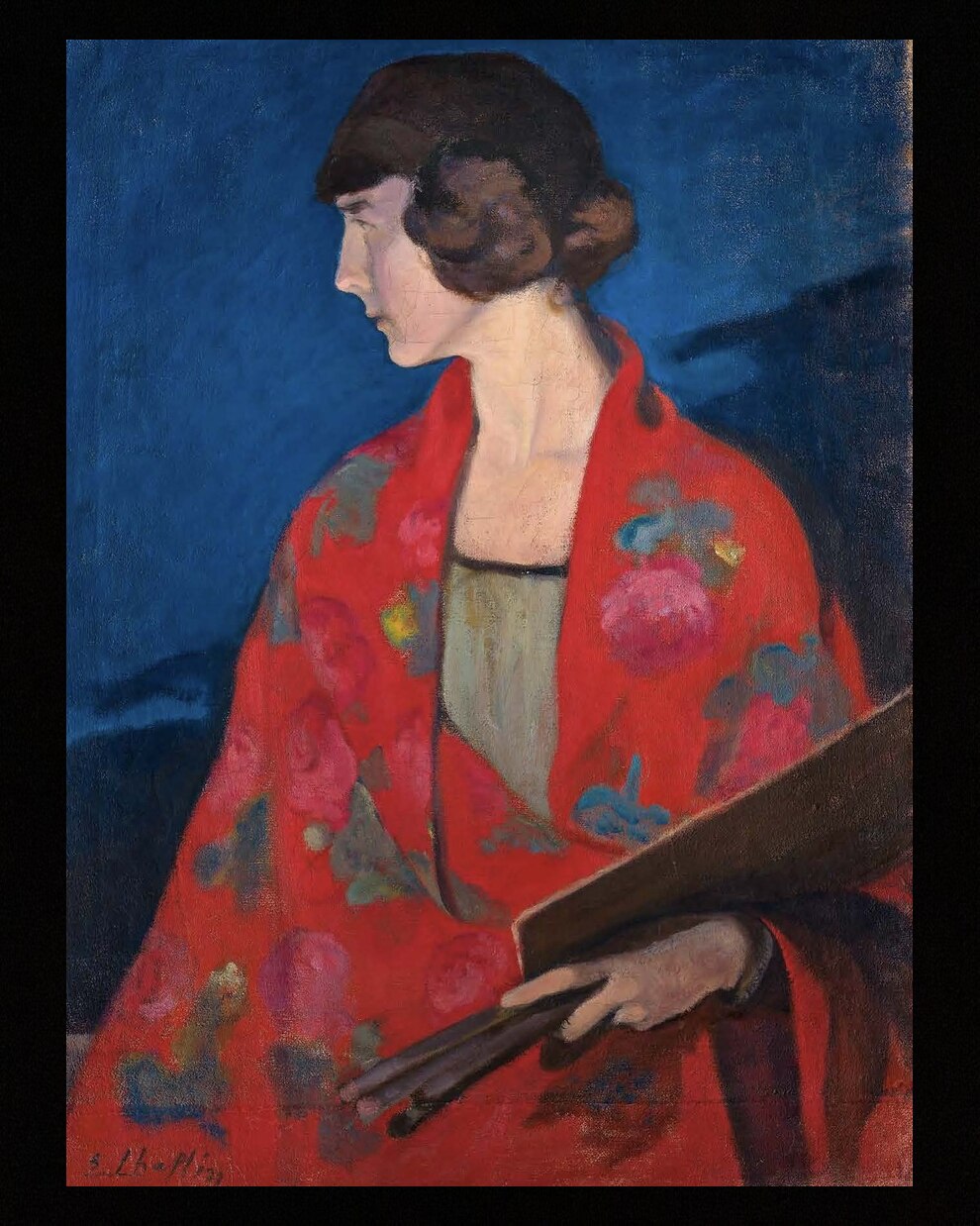
In the years from 1906 to 1916, Chaplin went on working as a perceptive portraitist, sought after by a discerning private clientele from Florence and elsewhere. Most importantly, she created such notable masterpieces as the extraordinary Self-Portrait with Red Shawl (1912) in the style of the Nabis. We may note the two-dimensional aspect that recalls Japanese prints, the concision of the draftsmanship and overall composition, the flat expanses of paint, and the light emanating from the bright colors. Among her other significant paintings, let us mention: Reading, showing the delicate bond between Nenette and her mother, acquired by the City of Florence for what was then the Royal Gallery of Modern Art, and the memorable Nenette with Violin (1914), shown at the Venice Biennale and acquired by the government for the National Gallery of Modern Art in Rome.
The Great War persuaded the family to move to Rome. There, the Chaplin family, entirely female save for the nightingale Pico (a gift for their departure from Il Treppiede), could rely on support from the embassy. Élisabeth enjoyed access to the French artistic world at Villa Medici. There she met Albert Besnard, the director, who was also a painter and engraver. He expressed his appreciation for her, advising her, putting her in touch with collectors, and urging her to go to Paris, a mandatory stop for any aspiring artist. Élisabeth recalled about him, with some irony: “He told me: ‘Ah, how intelligent you are. You’ve done nothing with all the advice I gave you!” The family took up residence at 38 Via Gregoriana but they spent the summer in Cave, in the Roman countryside, and there rebuilt a sort of mini-Treppiede. At this time, Marguerite embraced the Catholic faith, though with what degree of conviction remains unknown. Metaphysical Painting emerged around this period, in the works of artists such as Giorgio de Chirico, Carlo Carrà, Giorgio Morandi, and Alberto Savinio. Between 1916 and 1922, Élisabeth produced some twenty paintings, a few of which were truly important. The compositions featured the usual Chaplin clan, with Nenette and Ida up front, flanked by Trotti the dog, Bucchi the house cat, and Pico, the nightingale. Pico whistled at everyone but sang only for Élisabeth, as she herself recounted to Luciano Berti, among others.
During these years, Élisabeth’s artistic style changed and grew. Her line became stronger and more decisive, her palette brightened, the light in her work became warmer and stronger, spatial aspects became less prominent, and her paint became less flat. A greater decorative sense infused both figures and objects, as can be seen in the canvases Nenette with Pico’s Cage, Nenette on the Bench, and Nenette and Ida in the Garden, all of these from 1917-1918. In the lovely Nenette and Trotti, again, from 1917, now in a London collection, the frontal stance of the figures establishes a composition reminiscent of Manet, while the large expanses of color hearken back to the Nabis.
In 1920, with the assistance of Albert Besnard, she was able to exhibit at the Salon Nationale in Paris; she would be repeatedly invited back, until at least 1951.
Le Porcher and Les Filles du Pasteur were both praised by the highest reaches of French art criticism for their bright colors and light effects. Michel Dufet wrote: “Note at the Nationale how the painter Élisabeth Chaplin has shown two magnificent canvases, and in particular Les Filles du Pasteur, painted with power and sensitivity.”
When Vittorio Pica was informed of her success in Paris, he invited her to take part in the Venice Biennale, where she would continue to show until 1928. Élisabeth’s sent several major works to Venice: Nenette with Pico’s Cage, L’Age d’Or, and The Flock.
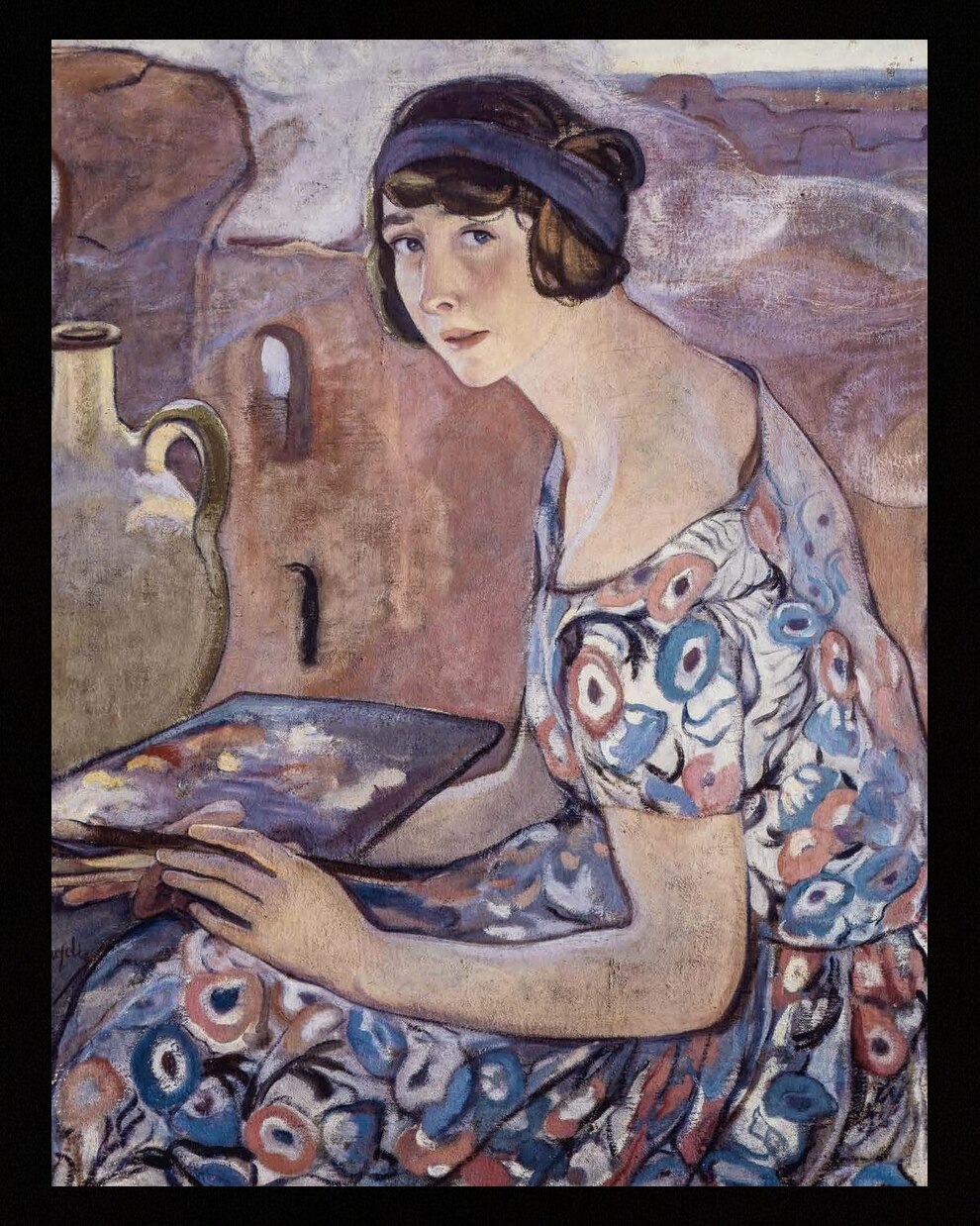
At the 1921 Salon d’Automne, she exhibited a delicate self-portrait: Self-Portrait in Pink, inspired by Félix Vallotton’s vivid and intense chromatic sensibility, while the sharp outlines and the arabesque of the dress – almost a hieroglyphic script – were evocative of Maurice Denis’s highly decorative taste. The background with ruins gives the entire scene an intimate and enigmatic quality.
In 1921, Élisabeth changed both style and subjects. Perhaps it was appropriate that Giovanni Papini stated in that same period that “genius has the right to contradict itself from one day to the next.” She drew her subjects from the Bible, from history, from ancient Greek literature, and from Mediterranean mythology; her style of draftsmanship and painting leaned towards the sensuality of Mannerist and Baroque art. With these new themes, mythological characters were unfailingly depicted in the nude, as we know them from antique sculpture. Her color was ablaze and the improbable stacked agglomerations of animals, flowers, and fruit around the figures were dazzling. André Gide, who met Élisabeth in 1921 while she was working on her painting Daphnis et Chloé (he had gone to Via Gregoriana to meet Marguerite), had an opportunity to admire that same work again when it was shown at the Salon Nationale de Paris in 1922. The following year, Élisabeth sent a significant number of works to the Salon illustrating her new themes, including: Adam and Eve, Demeter and Persephone, Saint Francis, Women Picking Grapes, and Shepherdesses. Her new artistic approach was well received. Arsène Alexandre commented: “Mademoiselle Chaplin possesses or has conquered the rarest quality of these times: a true personality. Her painting is luminous without clamor, without heaviness. Her drawings tend toward the grand; her interpretation of myth redounds with ascetic paganism. Without a doubt, Mademoiselle Chaplin is someone of note.”
After visiting the exhibition, André Gide wrote the artist an impassioned letter. “Mademoiselle, I must tell you that I was amazed at your canvases. I went straight for them, and, although I was familiar with one alone, I immediately recognized the others as yours: yes, already from afar, I understood, felt, that they could only be yours. I love each and every one, more than I can ever say; they emanate a deep, broad sensuality, a fullness, an ease, and that sort of smiling gravity that belongs to works that are bound to last. Ah, how happy I am to know you! Ah, how I would like to know you better! Do not forget me overmuch, please, and kindly give my regards to your mother. I am very sincerely yours, André Gide.” In her work from this period, we can sense a stylistic inconsistency, despite André Gide’s appreciation and the illustrious commissions that Chaplin received: the commission from the famous pianist Alfred Cortot, for example, to create a work for his dining room.
When Vittorio Pica was informed of her success in Paris, he invited her to take part in the Venice Biennale, where she would continue to show until 1928. Élisabeth’s sent several major works to Venice: Nenette with Pico’s Cage, L’Age d’Or, and The Flock.
At the 1921 Salon d’Automne, she exhibited a delicate self-portrait: Self-Portrait in Pink, inspired by Félix Vallotton’s vivid and intense chromatic sensibility, while the sharp outlines and the arabesque of the dress – almost a hieroglyphic script – were evocative of Maurice Denis’s highly decorative taste. The background with ruins gives the entire scene an intimate and enigmatic quality.
In 1921, Élisabeth changed both style and subjects. Perhaps it was appropriate that Giovanni Papini stated in that same period that “genius has the right to contradict itself from one day to the next.” She drew her subjects from the Bible, from history, from ancient Greek literature, and from Mediterranean mythology; her style of draftsmanship and painting leaned towards the sensuality of Mannerist and Baroque art. With these new themes, mythological characters were unfailingly depicted in the nude, as we know them from antique sculpture. Her color was ablaze and the improbable stacked agglomerations of animals, flowers, and fruit around the figures were dazzling. André Gide, who met Élisabeth in 1921 while she was working on her painting Daphnis et Chloé (he had gone to Via Gregoriana to meet Marguerite), had an opportunity to admire that same work again when it was shown at the Salon Nationale de Paris in 1922. The following year, Élisabeth sent a significant number of works to the Salon illustrating her new themes, including: Adam and Eve, Demeter and Persephone, Saint Francis, Women Picking Grapes, and Shepherdesses. Her new artistic approach was well received. Arsène Alexandre commented: “Mademoiselle Chaplin possesses or has conquered the rarest quality of these times: a true personality. Her painting is luminous without clamor, without heaviness. Her drawings tend toward the grand; her interpretation of myth redounds with ascetic paganism. Without a doubt, Mademoiselle Chaplin is someone of note.”
After visiting the exhibition, André Gide wrote the artist an impassioned letter. “Mademoiselle, I must tell you that I was amazed at your canvases. I went straight for them, and, although I was familiar with one alone, I immediately recognized the others as yours: yes, already from afar, I understood, felt, that they could only be yours. I love each and every one, more than I can ever say; they emanate a deep, broad sensuality, a fullness, an ease, and that sort of smiling gravity that belongs to works that are bound to last. Ah, how happy I am to know you! Ah, how I would like to know you better! Do not forget me overmuch, please, and kindly give my regards to your mother. I am very sincerely yours, André Gide.” In her work from this period, we can sense a stylistic inconsistency, despite André Gide’s appreciation and the illustrious commissions that Chaplin received: the commission from the famous pianist Alfred Cortot, for example, to create a work for his dining room.
We should however note certain surprises, works of undeniable quality and genius, such as the Phaedra of 1923, now in a Swiss collection. It is a true Symbolist masterpiece for its line and its inventive and decorative approach. There is also Reclining Nude of 1925, which – along with the Naiads of 1923 – reveals the artist’s interest in and affinity for the less erotic, less sensual, polished, and pearly nudes of a great painter such as Jean-Jacques Henner.
In the frigid January of 1924, Élisabeth’s alter-ego Pico died. One of the first to be informed, Gide wrote her with his condolences and a few affectionate and emotional lines. “Dear Mademoiselle, I remember my grief as a child when the little nightingale I kept died; it had been my companion for only a month... I imagine your grief, and I thank you for understanding my sympathy. Do you remember that you gave me a portrait of Pico?”
Angiolo Orvieto also wrote some verse in memoriam for the little nightingale. In 1925, the year of the Exposition des Arts Décoratifs, Chaplin sent a work to the Salon entitled The Awakening of the Earth, in which the figures of Zephyr and Flora emerge in accordance with prescribed fifteenth-century iconography, bound together as if in a pas-de-deux in a serene rural landscape, while allegorical figures posed in the Mannerist style animate and complete the scene.
In her quest for “beauty” she remained inconsistent: she moved from the Arcadian and bucolic vision of Daphnis et Chloé (1921) to blatant eroticism in Demeter and Persephone, to more restrained sensuality in works like Nu couché (Reclining Nude). The enfant prodige was beginning to show signs of fatigue.
In 1927 the Order of the Assumptionists commissioned her to paint two large panels with the subjects of the Annunciation and the Nativity for the church of Notre-Dame du Salut, located near the Grand Palais (the panels have since been lost, and the church was demolished in 1983). Élisabeth presented the cycle of paintings at the Salon, where it was favorably received. At the Salon of 1927, Chaplin was awarded the Puvis de Chavannes Prize for a cycle of paintings commissioned by Alfred Cortot. Included were three allegories (Jeunesse, Vendange, Musique, that is Youth, Harvest, and Music), which were heavily influenced by Baroque painting. Together with the Cortot triptych, she exhibited Baigneuses (purchased by the French government for the Musée du Luxembourg, but now at the Musée de Beaux-Arts in Le Havre). Meanwhile, Nu couché was exhibited at the Musée d’Art Moderne in Paris, a painting which marked the end of Nenette’s career as a model. This last work constituted a post-Ingres inspired expression of the sensual softness of Jean-Jacques Henner.
In the frigid January of 1924, Élisabeth’s alter-ego Pico died. One of the first to be informed, Gide wrote her with his condolences and a few affectionate and emotional lines. “Dear Mademoiselle, I remember my grief as a child when the little nightingale I kept died; it had been my companion for only a month... I imagine your grief, and I thank you for understanding my sympathy. Do you remember that you gave me a portrait of Pico?”
Angiolo Orvieto also wrote some verse in memoriam for the little nightingale. In 1925, the year of the Exposition des Arts Décoratifs, Chaplin sent a work to the Salon entitled The Awakening of the Earth, in which the figures of Zephyr and Flora emerge in accordance with prescribed fifteenth-century iconography, bound together as if in a pas-de-deux in a serene rural landscape, while allegorical figures posed in the Mannerist style animate and complete the scene.
In her quest for “beauty” she remained inconsistent: she moved from the Arcadian and bucolic vision of Daphnis et Chloé (1921) to blatant eroticism in Demeter and Persephone, to more restrained sensuality in works like Nu couché (Reclining Nude). The enfant prodige was beginning to show signs of fatigue.
In 1927 the Order of the Assumptionists commissioned her to paint two large panels with the subjects of the Annunciation and the Nativity for the church of Notre-Dame du Salut, located near the Grand Palais (the panels have since been lost, and the church was demolished in 1983). Élisabeth presented the cycle of paintings at the Salon, where it was favorably received. At the Salon of 1927, Chaplin was awarded the Puvis de Chavannes Prize for a cycle of paintings commissioned by Alfred Cortot. Included were three allegories (Jeunesse, Vendange, Musique, that is Youth, Harvest, and Music), which were heavily influenced by Baroque painting. Together with the Cortot triptych, she exhibited Baigneuses (purchased by the French government for the Musée du Luxembourg, but now at the Musée de Beaux-Arts in Le Havre). Meanwhile, Nu couché was exhibited at the Musée d’Art Moderne in Paris, a painting which marked the end of Nenette’s career as a model. This last work constituted a post-Ingres inspired expression of the sensual softness of Jean-Jacques Henner.
In 1927, Jean-Jacques’ son Robert arrived at Il Treppiede; handsome but afflicted with muscular dystrophy, his arrival was seen as a divine benediction, in part because the boy proved to have inherited his family’s and his forebears’ artistic gene. He showed up planning to stay for only a few days, but instead remained until the year of his death, in 1937. A fine artistic endeavor by Élisabeth in this period, well composed and excellent in quality, was the Boys on the Arno (1930-1932), a study of Signorelli and Antonio Pollaiolo’s “heroic nudes.”
The year 1937 was a terrible one for the Chaplin family. In addition to Robert, William died; the following year, their friends Carlo and Nello Rosselli were killed. After these bereavements, Élisabeth was unable to rejoice at being awarded the Legion of Honor the following year. Then World War II broke out and Élisabeth and her mother were arrested. Élisabeth was dressed elegantly at the time of their arrest, with gloves and a theatrical white parasol, before they were transferred to Santa Verdiana women’s prison: that is how the French painter Fernand Riblet (1873-1944) described the episode to Angela France Bargagli Petrucci, who later recounted it to me.
In the postwar years, Élisabeth traveled extensively in Europe and went to England to visit Nenette, whose marriage was breaking up. In the decade from 1950 to 1960, members of the Florentine nobility and upper middle class requested numerous portraits of themselves and their progeny from her.
A number of retrospective exhibitions were devoted to Chaplin’s work in Florence: at Palazzo Strozzi (1946), the Leonardo da Vinci Society (1947), the Academy of Arts and Design (1956), the Lyceum (1960), the French Institute (1965), and the Michelucci Gallery (1972).
In 1967, her mother Marguerite died, as did her beloved companion Ida Capecchi in 1971. With proud determination, the artist continued painting despite the painful arthritis affecting her hands. Some aspects of Il Treppiede remained as mute testimonials to her artistic and emotional life. There may no longer have been the beloved people, but there were the doves, descendants of those from the past, as well as the path, the almond tree, the oleander and other trees, the flowers. As memories and regrets continued to accumulate, she went on painting until 1974, when she unexpectedly decided to donate to the city of Florence the complete collection of her own work and that of her family. It was a gesture of gratitude to the city that had welcomed her and where her career had been launched. On the day the work was moved to Palazzo Pitti, in 1979, officials from the Superintendency, art historians, public administrators, and the curious public all flocked to attend the event. Chaplin thanked and greeted everyone, and finally asked to shake hands with the man who had transported all the work. After all, she said – with fine French irony – he was the most important member of the company.
Cristina Nuzzi
translation by Laurel Saint Pierre, Antony Shugaar
The year 1937 was a terrible one for the Chaplin family. In addition to Robert, William died; the following year, their friends Carlo and Nello Rosselli were killed. After these bereavements, Élisabeth was unable to rejoice at being awarded the Legion of Honor the following year. Then World War II broke out and Élisabeth and her mother were arrested. Élisabeth was dressed elegantly at the time of their arrest, with gloves and a theatrical white parasol, before they were transferred to Santa Verdiana women’s prison: that is how the French painter Fernand Riblet (1873-1944) described the episode to Angela France Bargagli Petrucci, who later recounted it to me.
In the postwar years, Élisabeth traveled extensively in Europe and went to England to visit Nenette, whose marriage was breaking up. In the decade from 1950 to 1960, members of the Florentine nobility and upper middle class requested numerous portraits of themselves and their progeny from her.
A number of retrospective exhibitions were devoted to Chaplin’s work in Florence: at Palazzo Strozzi (1946), the Leonardo da Vinci Society (1947), the Academy of Arts and Design (1956), the Lyceum (1960), the French Institute (1965), and the Michelucci Gallery (1972).
In 1967, her mother Marguerite died, as did her beloved companion Ida Capecchi in 1971. With proud determination, the artist continued painting despite the painful arthritis affecting her hands. Some aspects of Il Treppiede remained as mute testimonials to her artistic and emotional life. There may no longer have been the beloved people, but there were the doves, descendants of those from the past, as well as the path, the almond tree, the oleander and other trees, the flowers. As memories and regrets continued to accumulate, she went on painting until 1974, when she unexpectedly decided to donate to the city of Florence the complete collection of her own work and that of her family. It was a gesture of gratitude to the city that had welcomed her and where her career had been launched. On the day the work was moved to Palazzo Pitti, in 1979, officials from the Superintendency, art historians, public administrators, and the curious public all flocked to attend the event. Chaplin thanked and greeted everyone, and finally asked to shake hands with the man who had transported all the work. After all, she said – with fine French irony – he was the most important member of the company.
Cristina Nuzzi
translation by Laurel Saint Pierre, Antony Shugaar
Cristina Nuzzi studied at the University of Florence with Mina Gregori. In the years from 1979 to 1985 she curated a great many exhibitions, including: Quarant’anni di spettacolo in Italia attraverso l’opera di Maria de’ Matteis (Florence, 1979); Arnold Böcklin e la cultura artistica in Toscana (1980, Fiesole), Franco Maria Ricci Editore e Designer (Fiesole 1982); Fortuny e la belle Époque (Palazzo Strozzi, Florence, 1982). In 1985, she wrote and directed the three-episode documentary Viaggio nei luoghi degli Etruschi for Istituto Luce and RAI 2. She has worked with a number of publishing houses, including this one.
All paintings published with this article are by Élisabeth Chaplin (1890-1982).
All paintings published with this article are by Élisabeth Chaplin (1890-1982).


