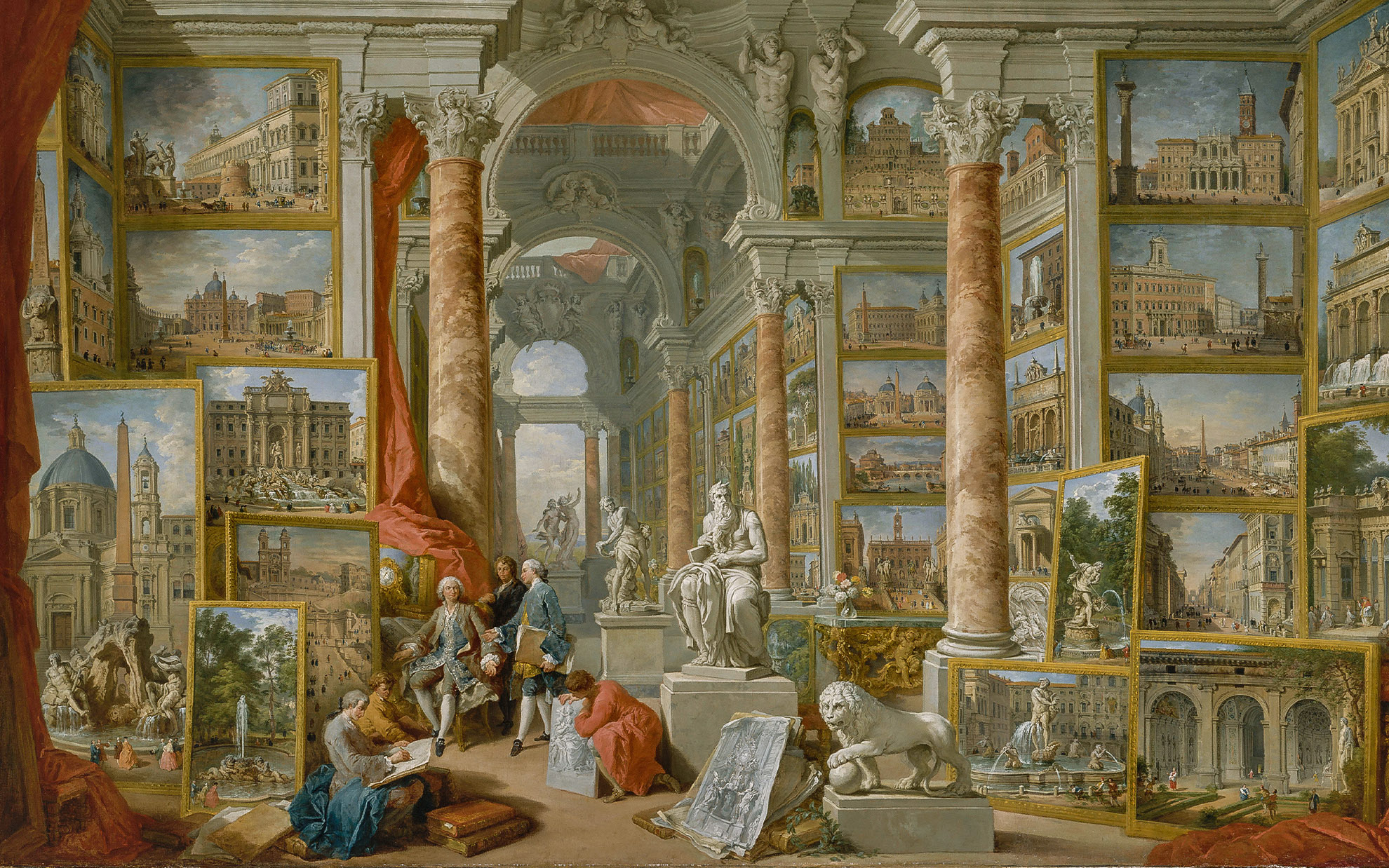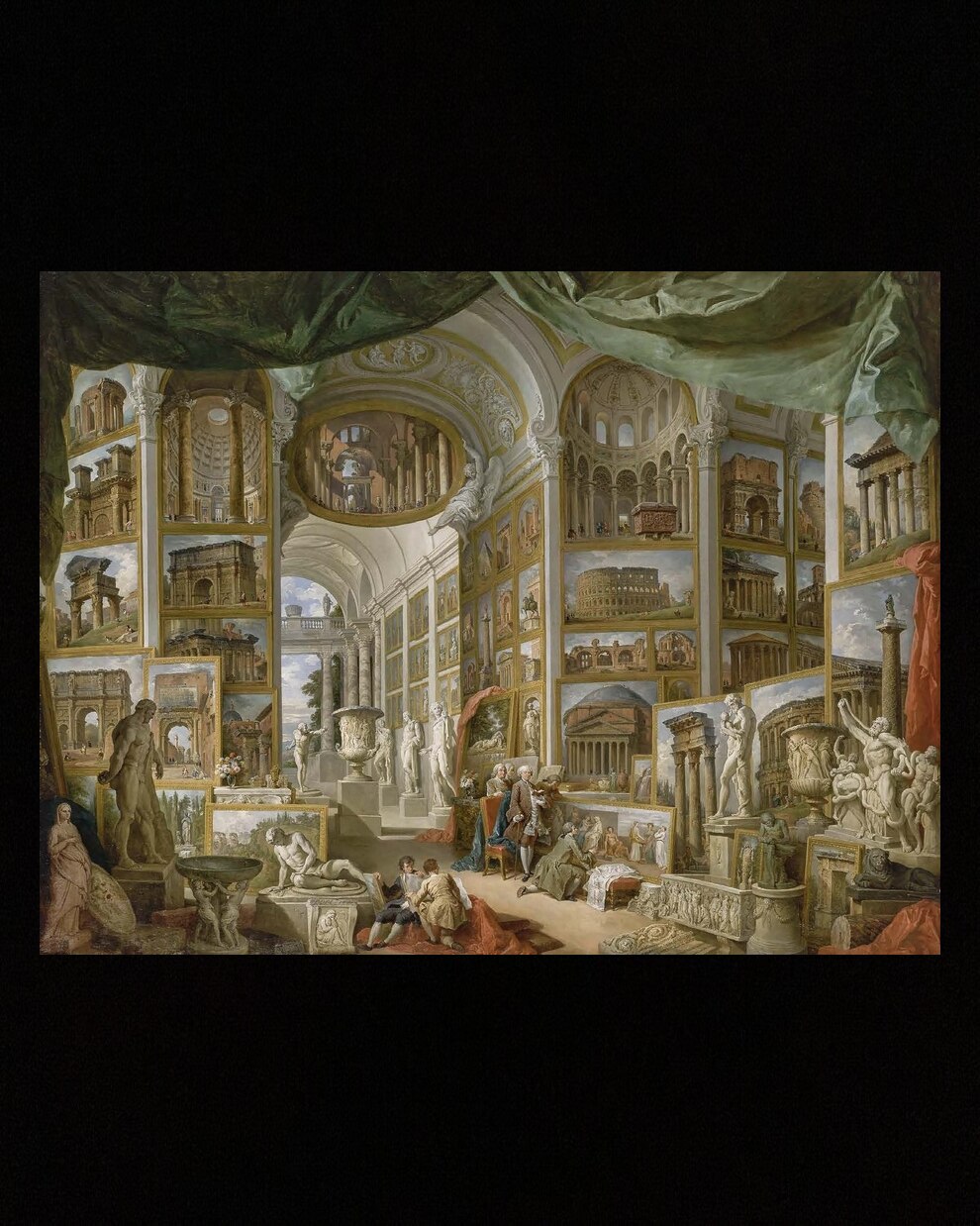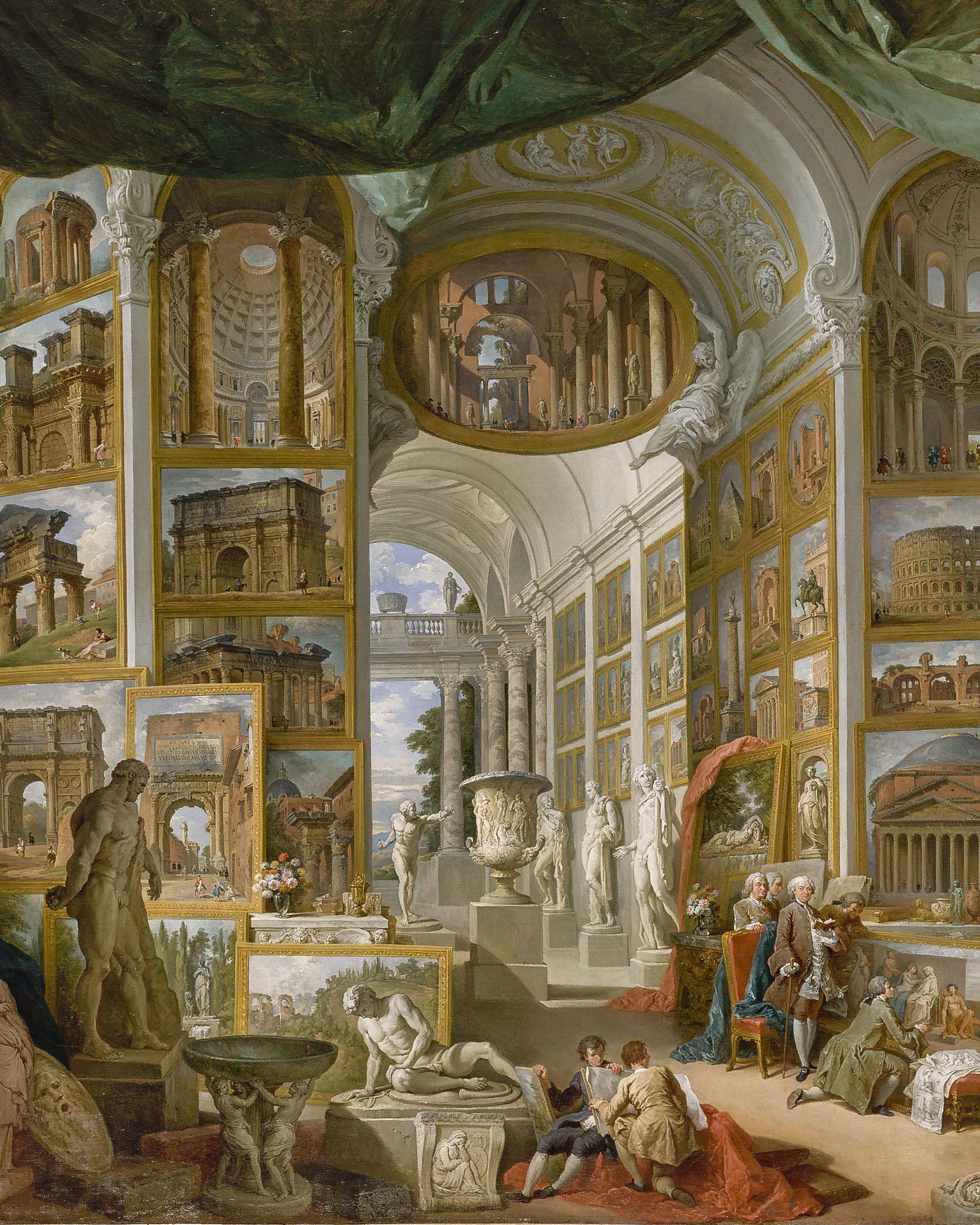
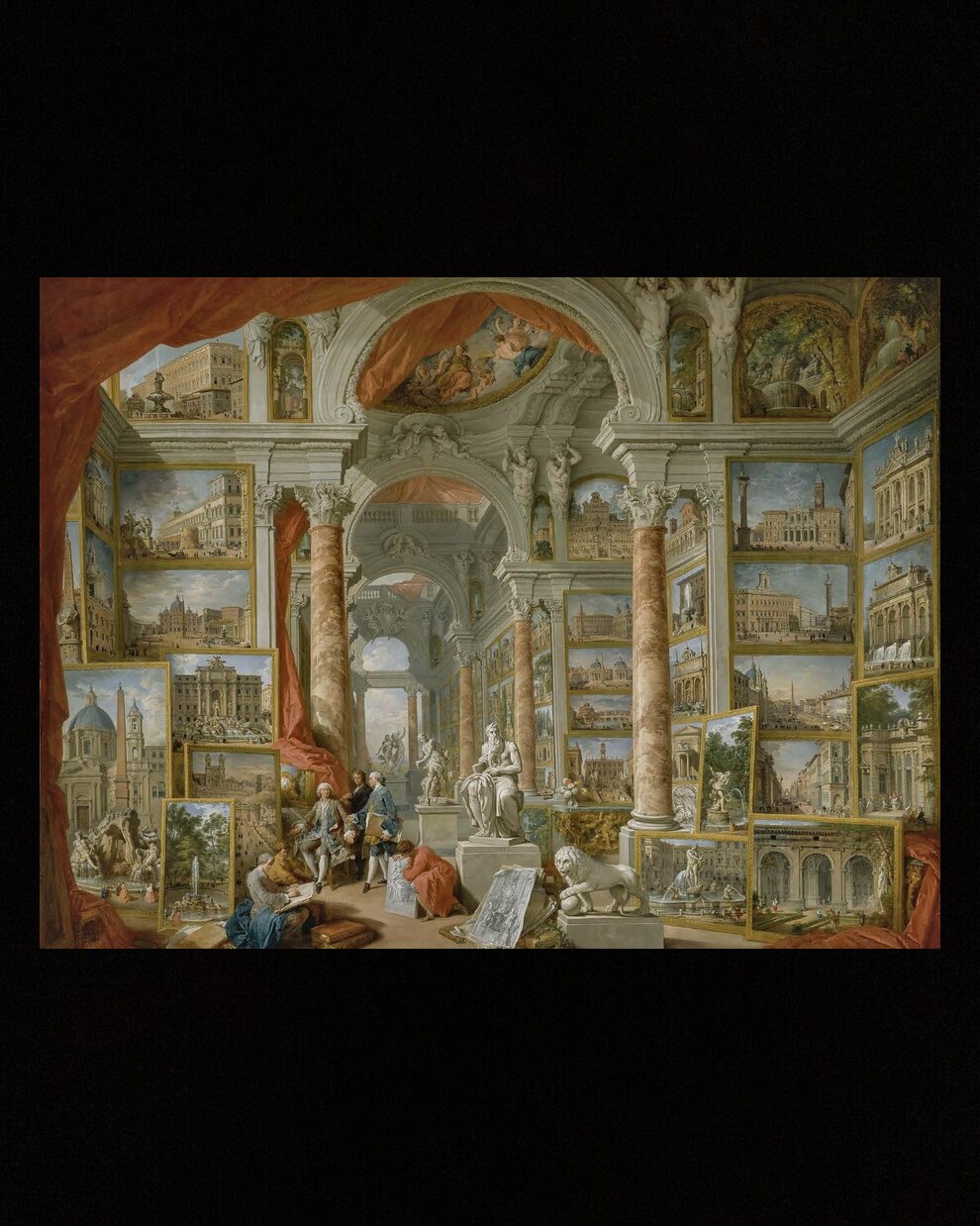
Once a week, Mr. PA walks the thirty-five minutes from his home in New York to the Metropolitan Museum of Art to look at the two paintings he always goes to see. After entering the museum and presenting his membership card, he slowly climbs the wide and dimly lit staircase, filled with a rising sense of anticipation at the belief that this time he might actually arrive at a deeper understanding of the two large oil paintings upstairs (Views of Ancient Rome and Views of Modern Rome) that he still doesn’t feel he has fully taken in.
Both paintings are by Panini (whose full name was Giovanni Paolo Panini or Pannini).
A magazine publisher has asked Mr. PA to write an essay about the two works after learning how much time he spends staring at them. Mr. PA has accepted the offer because he has always wanted to be a painter, and in fact prefers painting to literature – despite being a professor of literature. Over the past twenty-five years, Mr. PA, who regrets not becoming a painter, has been eager to become more involved in the world of painters, artists, curators, and museum directors.
To reach the Paninis on the second floor of the Metropolitan museum, he must first cross a small room covered on all four walls with paintings by Giovanni Battista Tiepolo – where he invariably feels that something is about to fall out of the sky and the Heavens and hit him on the head. Then he sits in front of the first canvas, Modern Rome (1757), and begins to look.
As he stares unmovingly at this painting, which measures 172.1 x 233 cm, Mr. PA tries his best not to think of anything, and to let his gaze roam free. As usual, his eyes begin to dart around various corners of the painting, like a dog out for a walk on a familiar field, joyfully sniffing every familiar nook. There’s Michelangelo’s sculpture of Moses, which is always the first thing he notices. There’s Étienne François, Count of Stainville, Duc de Choiseul, who commissioned the painting from Panini, and there’s Bernini’s David. From the magnificent art gallery contained within the painting, Mr. PA’s eyes shift to the immense columns that are bearing the room’s artistic and spiritual weight, and to the arch above them.
Having grown accustomed to the works of art inside the work of art, Mr. PA’s gaze now lingers on the swath of red fabric, the enormous curtain which hangs like a veil from above the arch down towards the ground, and serves as a kind of frame for the whole painting (in Ancient Rome, the other Panini – a symmetrical sibling – that hangs in this room, that same cloth is painted blue). Having thus established with this first glance that everything in the museum and in the painting is in its rightful place, Mr. PA begins to ask himself the questions he feels duty-bound to explore, and to which he discovers new answers with every visit.
Why has he made a habit of coming to look at Panini’s Modern Rome and Ancient Rome?
1. As their names suggest, the two paintings catalogue the one hundred and eleven best-known sights of Rome in 1757 (Modern Rome) and in the classical age (Ancient Rome), in the form of paintings within paintings. Mr. PA loves Rome, and the lifelike Roman vistas offered by the two works are so rich and so variform that his eyes never seem to run out of things to look at. Thinking there may be something there that he has failed to understand, to spot, to recognize, or to remember, he can only bring himself to get up and leave the museum once he has already made his mind up to come back.
2. In this room of the Metropolitan Museum, there is a bench facing each of the two paintings. Mr. PA takes great pleasure in sitting there, accustomed as he is to complaining that the large galleries inside this enormous museum never seem to be equipped with enough seats or benches where one can sit and contemplate a painting at leisure. Mr. PA sometimes thinks that there are many paintings he would be perfectly capable of observing at great length if only they came with a bench to sit and look from. He notes that there is no other gallery in the museum with two benches positioned side by side, and likes to think that the curators must have wanted visitors to sit and gaze lengthily at ancient and modern Rome.
3. Most visitors to the museum don’t even seem to be aware of the curators’ intentions for this room. The vast majority of people who walk into this spacious gallery on the second floor slow down as they pass the first painting, but never sit on the benches. Most of them understand that this first painting consists essentially of a catalogue of numerous beautiful views and monuments from the city of Rome, arranged as a sort of ‘collection of tourist postcards’. Some break immediately into a faint smile, signaling their appreciation of the work. Panini’s skill lies in the delightful way he has arranged each of these individual postcard-like paintings inside an enormous fictional art gallery. But unlike Mr. PA, most visitors that show any interest in the painting don’t actually stop to examine each of its Roman landscapes one by one. Usually they keep moving forward, and soon, they’re gone.
Some of the paintings inside the paintings have been framed and hung, others are leaning against something, some have been painted directly onto the walls, and others have been molded to fit around a fold in the wall or inside a dome, all with a careful eye to perspective. Studying this wealth of images and landscapes, the observer immediately notices the use of perspective, a technique which was of particular interest to Panini, and to which both the whole gallery and each of its component paintings unerringly defer. Panini was a master of perspective.
When he first started sitting down in front of these paintings, Mr. PA used to assume that the people who walked past without taking any notice probably didn’t know Rome at all. Even so, shouldn’t we also be interested in views of cities we’re not acquainted with? Perhaps the more important question is: Do people come to museums to see things they already know about, or to discover something completely new? Some will spare Panini’s paintings a glimpse out of the corner of their eye, chatting to each other (not even in a whisper) as they walk past, some will read the label to find out who the artist is, and some will slow down just a little bit, glancing at the painting for a few moments before moving on. Mr. PA can tell that Panini isn’t a particularly well-known painter from the facial expressions of those who pause to read the label, which show no inkling of recognition. Mr. PA thinks to himself that perhaps the reason he loves these paintings is that he spends so much time sitting across from them. And sometimes he catches himself enumerating all the things he and Panini have in common.
1. Both their surnames begin with Pa.
2. Both Panini and Mr. PA studied architecture. Later, Mr. PA devoted himself to literature, and has always regretted not making architectural paintings in the style of Panini.
3. Like Panini, Mr. PA was fascinated with the subject and technique of perspective, both in middle school and when he later went on to study architecture. Mr. PA attributes the “success” of Panini’s paintings Ancient Rome and Modern Rome not only to the allure of the Roman vistas they depict, but also to the artist’s ability to adhere perfectly to the laws of perspective as he places them within the context of these grand imaginary art galleries.
4. With his books and writings, Mr. PA is really doing for Istanbul what Panini did for Rome. He is, in other words, telling the story of Istanbul old and new. (But Mr. PA would like to believe that his books, unlike Panini’s paintings, are widely read because of his skill and creativity as a writer, rather than for touristic views of Istanbul.)
5. Mr. PA is also intrigued by the fact that Panini did not just stick to realistic paintings of Roman vistas, but created “imaginary” ones too. As well as postcard-style Vedute depicting the city’s most famous sights, he also enjoyed casting true details aside to create Capriccios containing made-up elements and imaginary topographies. Sometimes Mr. PA wonders what he would do, what he would choose to portray, if he were to start doing what Panini did and paint fictional Istanbul views – creating, in other words, Capriccios of Istanbul.
6. As every Turkish school boy knows both Rome and Istanbul are founded on seven hills. The website of the Metropolitan Museum contains information on where the sights depicted in these two paintings are to be found. Every week, before he heads for the museum, Mr. PA visits the website on his home computer and goes through the list. He doesn’t spend too much time on the more famous spots like the Trevi Fountain, the Pantheon, Piazza Farnese, and the Quirinale area. But he does linger at some length on those other places which the website labels as an “Unidentified location”. As if he were trying to recall a memory he made in ancient Rome and has since forgotten.
Places marked as unknown locations abound particularly in the painting titled Ancient Rome. Could these be sites and monuments that have genuinely been forgotten, Mr. PA wonders, or are they actually Capriccios, imaginary vistas that Panini invented? As some of the paintings are leaning sideways against the wall, they are sometimes partially covered by other paintings or various superfluous objects (vases and flowers), making it difficult to see the full view they depict. This directs Mr. PA ’s imagination towards the connection between real places lost in the folds of history and the later creation of imaginary locations. Mr. PA believes that it is the secret intention of great art and literature to mix together the factual and the fictional in order to nurture an appreciation for an invisible reality. As he meditates on this belief, he asks himself what truth it is that Panini’s two large canvases have made him appreciate, and admits to himself that his favorite thing in life is to get lost inside the landscape of a city.
Like Panini, Mr. PA would have liked to write in his books about those corners of his own city (Istanbul) that history has forgotten, or that are likely to be forgotten, and thus save them from oblivion. But what has intrigued Mr. PA even more in recent weeks is the sense of profundity that has begun to come over him whenever he sits in front of these two large canvases. Struck by this new emotion, which he did not experience when he saw the paintings for the first time many years ago, Mr. PA feels as if he were surrounded not just by the one hundred and eleven Roman vistas that Panini portrays through paintings within paintings, but by the city of Rome as a whole. This feeling ignites in him the urge to look at the paintings once more. Mr. PA decides to identify his place in both ancient and modern Rome by studying these paintings within paintings – just like someone finding their way around a city – and realizes that the best way to do this would be to examine a map of Rome at home before his next trip to the museum. On his following visit, as he is blissfully examining each of the paintings, he starts doing something he often does: he reads out the names of all the monuments and old Roman neighborhoods, finding a sense of poetry in these toponyms. Upon spotting, on this latest trip, a forgotten piazza that even the experts cannot recognize, Mr. PA determines that this particular visit has come to an end... And on his way home, the vague thought occurs to him, as it has done before, that visiting museums evokes in him a kind of satisfaction, as if he’d had a small hand himself in creating the paintings he has just been admiring.
Orhan Pamuk
traduzione di Ekin Oklap
Both paintings are by Panini (whose full name was Giovanni Paolo Panini or Pannini).
A magazine publisher has asked Mr. PA to write an essay about the two works after learning how much time he spends staring at them. Mr. PA has accepted the offer because he has always wanted to be a painter, and in fact prefers painting to literature – despite being a professor of literature. Over the past twenty-five years, Mr. PA, who regrets not becoming a painter, has been eager to become more involved in the world of painters, artists, curators, and museum directors.
To reach the Paninis on the second floor of the Metropolitan museum, he must first cross a small room covered on all four walls with paintings by Giovanni Battista Tiepolo – where he invariably feels that something is about to fall out of the sky and the Heavens and hit him on the head. Then he sits in front of the first canvas, Modern Rome (1757), and begins to look.
As he stares unmovingly at this painting, which measures 172.1 x 233 cm, Mr. PA tries his best not to think of anything, and to let his gaze roam free. As usual, his eyes begin to dart around various corners of the painting, like a dog out for a walk on a familiar field, joyfully sniffing every familiar nook. There’s Michelangelo’s sculpture of Moses, which is always the first thing he notices. There’s Étienne François, Count of Stainville, Duc de Choiseul, who commissioned the painting from Panini, and there’s Bernini’s David. From the magnificent art gallery contained within the painting, Mr. PA’s eyes shift to the immense columns that are bearing the room’s artistic and spiritual weight, and to the arch above them.
Having grown accustomed to the works of art inside the work of art, Mr. PA’s gaze now lingers on the swath of red fabric, the enormous curtain which hangs like a veil from above the arch down towards the ground, and serves as a kind of frame for the whole painting (in Ancient Rome, the other Panini – a symmetrical sibling – that hangs in this room, that same cloth is painted blue). Having thus established with this first glance that everything in the museum and in the painting is in its rightful place, Mr. PA begins to ask himself the questions he feels duty-bound to explore, and to which he discovers new answers with every visit.
Why has he made a habit of coming to look at Panini’s Modern Rome and Ancient Rome?
1. As their names suggest, the two paintings catalogue the one hundred and eleven best-known sights of Rome in 1757 (Modern Rome) and in the classical age (Ancient Rome), in the form of paintings within paintings. Mr. PA loves Rome, and the lifelike Roman vistas offered by the two works are so rich and so variform that his eyes never seem to run out of things to look at. Thinking there may be something there that he has failed to understand, to spot, to recognize, or to remember, he can only bring himself to get up and leave the museum once he has already made his mind up to come back.
2. In this room of the Metropolitan Museum, there is a bench facing each of the two paintings. Mr. PA takes great pleasure in sitting there, accustomed as he is to complaining that the large galleries inside this enormous museum never seem to be equipped with enough seats or benches where one can sit and contemplate a painting at leisure. Mr. PA sometimes thinks that there are many paintings he would be perfectly capable of observing at great length if only they came with a bench to sit and look from. He notes that there is no other gallery in the museum with two benches positioned side by side, and likes to think that the curators must have wanted visitors to sit and gaze lengthily at ancient and modern Rome.
3. Most visitors to the museum don’t even seem to be aware of the curators’ intentions for this room. The vast majority of people who walk into this spacious gallery on the second floor slow down as they pass the first painting, but never sit on the benches. Most of them understand that this first painting consists essentially of a catalogue of numerous beautiful views and monuments from the city of Rome, arranged as a sort of ‘collection of tourist postcards’. Some break immediately into a faint smile, signaling their appreciation of the work. Panini’s skill lies in the delightful way he has arranged each of these individual postcard-like paintings inside an enormous fictional art gallery. But unlike Mr. PA, most visitors that show any interest in the painting don’t actually stop to examine each of its Roman landscapes one by one. Usually they keep moving forward, and soon, they’re gone.
Some of the paintings inside the paintings have been framed and hung, others are leaning against something, some have been painted directly onto the walls, and others have been molded to fit around a fold in the wall or inside a dome, all with a careful eye to perspective. Studying this wealth of images and landscapes, the observer immediately notices the use of perspective, a technique which was of particular interest to Panini, and to which both the whole gallery and each of its component paintings unerringly defer. Panini was a master of perspective.
When he first started sitting down in front of these paintings, Mr. PA used to assume that the people who walked past without taking any notice probably didn’t know Rome at all. Even so, shouldn’t we also be interested in views of cities we’re not acquainted with? Perhaps the more important question is: Do people come to museums to see things they already know about, or to discover something completely new? Some will spare Panini’s paintings a glimpse out of the corner of their eye, chatting to each other (not even in a whisper) as they walk past, some will read the label to find out who the artist is, and some will slow down just a little bit, glancing at the painting for a few moments before moving on. Mr. PA can tell that Panini isn’t a particularly well-known painter from the facial expressions of those who pause to read the label, which show no inkling of recognition. Mr. PA thinks to himself that perhaps the reason he loves these paintings is that he spends so much time sitting across from them. And sometimes he catches himself enumerating all the things he and Panini have in common.
1. Both their surnames begin with Pa.
2. Both Panini and Mr. PA studied architecture. Later, Mr. PA devoted himself to literature, and has always regretted not making architectural paintings in the style of Panini.
3. Like Panini, Mr. PA was fascinated with the subject and technique of perspective, both in middle school and when he later went on to study architecture. Mr. PA attributes the “success” of Panini’s paintings Ancient Rome and Modern Rome not only to the allure of the Roman vistas they depict, but also to the artist’s ability to adhere perfectly to the laws of perspective as he places them within the context of these grand imaginary art galleries.
4. With his books and writings, Mr. PA is really doing for Istanbul what Panini did for Rome. He is, in other words, telling the story of Istanbul old and new. (But Mr. PA would like to believe that his books, unlike Panini’s paintings, are widely read because of his skill and creativity as a writer, rather than for touristic views of Istanbul.)
5. Mr. PA is also intrigued by the fact that Panini did not just stick to realistic paintings of Roman vistas, but created “imaginary” ones too. As well as postcard-style Vedute depicting the city’s most famous sights, he also enjoyed casting true details aside to create Capriccios containing made-up elements and imaginary topographies. Sometimes Mr. PA wonders what he would do, what he would choose to portray, if he were to start doing what Panini did and paint fictional Istanbul views – creating, in other words, Capriccios of Istanbul.
6. As every Turkish school boy knows both Rome and Istanbul are founded on seven hills. The website of the Metropolitan Museum contains information on where the sights depicted in these two paintings are to be found. Every week, before he heads for the museum, Mr. PA visits the website on his home computer and goes through the list. He doesn’t spend too much time on the more famous spots like the Trevi Fountain, the Pantheon, Piazza Farnese, and the Quirinale area. But he does linger at some length on those other places which the website labels as an “Unidentified location”. As if he were trying to recall a memory he made in ancient Rome and has since forgotten.
Places marked as unknown locations abound particularly in the painting titled Ancient Rome. Could these be sites and monuments that have genuinely been forgotten, Mr. PA wonders, or are they actually Capriccios, imaginary vistas that Panini invented? As some of the paintings are leaning sideways against the wall, they are sometimes partially covered by other paintings or various superfluous objects (vases and flowers), making it difficult to see the full view they depict. This directs Mr. PA ’s imagination towards the connection between real places lost in the folds of history and the later creation of imaginary locations. Mr. PA believes that it is the secret intention of great art and literature to mix together the factual and the fictional in order to nurture an appreciation for an invisible reality. As he meditates on this belief, he asks himself what truth it is that Panini’s two large canvases have made him appreciate, and admits to himself that his favorite thing in life is to get lost inside the landscape of a city.
Like Panini, Mr. PA would have liked to write in his books about those corners of his own city (Istanbul) that history has forgotten, or that are likely to be forgotten, and thus save them from oblivion. But what has intrigued Mr. PA even more in recent weeks is the sense of profundity that has begun to come over him whenever he sits in front of these two large canvases. Struck by this new emotion, which he did not experience when he saw the paintings for the first time many years ago, Mr. PA feels as if he were surrounded not just by the one hundred and eleven Roman vistas that Panini portrays through paintings within paintings, but by the city of Rome as a whole. This feeling ignites in him the urge to look at the paintings once more. Mr. PA decides to identify his place in both ancient and modern Rome by studying these paintings within paintings – just like someone finding their way around a city – and realizes that the best way to do this would be to examine a map of Rome at home before his next trip to the museum. On his following visit, as he is blissfully examining each of the paintings, he starts doing something he often does: he reads out the names of all the monuments and old Roman neighborhoods, finding a sense of poetry in these toponyms. Upon spotting, on this latest trip, a forgotten piazza that even the experts cannot recognize, Mr. PA determines that this particular visit has come to an end... And on his way home, the vague thought occurs to him, as it has done before, that visiting museums evokes in him a kind of satisfaction, as if he’d had a small hand himself in creating the paintings he has just been admiring.
Orhan Pamuk
traduzione di Ekin Oklap
Orhan Pamuk was born in 1952 in Istanbul. In 2006, he was awarded the Nobel Prize for Literature, for which the jury noted that “in the quest for the melancholic soul of his native city, [he] has discovered new symbols for the clash and interlacing of cultures.” His many publications include My Name Is Red, Istanbul, The Museum of Innocence, and his latest book Nights of Plague. He is a professor of comparative literature at New York’s Columbia University.