
The works that appear in these pages belong to a bygone era, tracing their provenance to a world long vanished, one to which only a few images, even fewer objects, and an assortment of documents still bear witness. The time and place: fifteenth-century Rome. Martin V was elevated to the papal throne in 1417 and it was during his papacy that the Western Schism was resolved and the papal court returned to Rome after its exile to Avignon. The decades during which Rome had lived without its longstanding sovereign were stark and dramatic, like the fine objects discussed in these pages. The return of the Pope, the re-establishment of religious services and the rhythms of ritual, and an ample and operating curia brought artisans and artists back to the city. This period marked the emergence from the Middle Ages, which coincided with the surprising resurgence of antiquity and the Church’s renewed respect for the artistic expressions of paganism. It was a process that unfolded hesitantly at first, then with greater determination, at times becoming seemingly unstoppable: with the classicism of the first Michelangelo, who had come from Tuscany to Rome, then even more so, perhaps, with the second artist to bear that name, Caravaggio, who, although born in a more northern city, was no less powerful and determined; but since all things are ever changing, everything would become sweet and light one hundred years later, only to turn bloody again at the end of the eighteenth century.
The artifacts of extraordinary beauty presented here are documentation of this Renaissance Rome, its wealth and its return to classical ideals: tables with fine intarsia work, made with stones that had survived from another Rome, one ruled by the likes of Caesar and Augustus.
The main problem facing scholars interested in such tables produced in Renaissance Rome has to do with their chronology. Scholars have cautiously succeeded in establishing differences between those made in Rome around the mid-sixteenth century and others made, toward the end of that same century, in Florence. It is, in fact, easier to find documents concerning the fabrication of inlaid stone tables in Florence, where there was only one main client, the Grand Duke, than those made in Rome, where the record keeping of the papacy and, in particular, that of the aristocracy, was far less precise and more sporadic. This type of workmanship already seemed to be widespread in Rome by the mid-sixteenth century and was used in the architectural decoration of churches and chapels. The tables were luxury furnishings, and precise documentation is almost non-existent. The name of the artist and the date of creation remain uncertain, or virtually uncertain, even for the Farnese Table, the most celebrated example of this type of furniture. The chief difficulty in reconstructing the origins of Roman inlaid stone work has to do with the fact that virtually all artifacts were found on the antiquarian marketplace, which means that their provenance is often unknown.
Making matters even more complicated was the continuous exchange of ideas and materials between Rome and Florence.
We should mention here two major figures, both of them Tuscan cardinals. The first is Giovanni Ricci of Montepulciano (1498-1575), ordained cardinal in 1551, while the second is Ferdinando de’ Medici (1549-1609), who was cardinal from 1563 to 1588, leaving office shortly after becoming Grand Duke of Tuscany following the death of his brother Francesco. Both cardinals took an active interest in colorful stones and ancient marble, so much so that in 1588 Grand Duke Ferdinando founded a Galleria dei Lavori (Workshop Gallery), then housed on the ground floor of the Uffizi, where artisans fabricated objects using semiprecious stones, along with other types of luxury furnishings and fittings. A number of tables inlaid with colored marble now found in the museums of Florence, however, were made in Rome, where Ferdinando de’ Medici lived during his time as cardinal. One such table was made for Bindo Altoviti and designed by Giorgio Vasari, and featured jaspers bordered with ivory and set in ebony.
One essential aspect in the appreciation of this type of work is the quality of the design. There is a common tendency to mistake the name of the actual artisan physically responsible for a creation for the name of the person who had designed it. Although we do know, as stated above, the names of many sixteenth-century Roman stonecutters, we have no idea whether these artisans were also responsible for the designs. Jean Ménard, known in Rome at the time as “Il Franciosino,” was the best-known artisan in the field from the middle of the sixteenth century until 1582, but he appears to have been illiterate and we have no idea whether he was a capable designer. In contrast, numerous designs for table tops by the Tuscan architect Giovanni Antonio Dosio (1533-1611) still exist; it is likewise appropriate to mention Giovanni Vincenzo Casale, who was born in Florence around 1539 and died in Portugal in 1593. We cannot rule out the possibility that Casale was acquainted with Jean Ménard, since both men spent time with Michelangelo Buonarroti in Rome.
The artifacts of extraordinary beauty presented here are documentation of this Renaissance Rome, its wealth and its return to classical ideals: tables with fine intarsia work, made with stones that had survived from another Rome, one ruled by the likes of Caesar and Augustus.
The main problem facing scholars interested in such tables produced in Renaissance Rome has to do with their chronology. Scholars have cautiously succeeded in establishing differences between those made in Rome around the mid-sixteenth century and others made, toward the end of that same century, in Florence. It is, in fact, easier to find documents concerning the fabrication of inlaid stone tables in Florence, where there was only one main client, the Grand Duke, than those made in Rome, where the record keeping of the papacy and, in particular, that of the aristocracy, was far less precise and more sporadic. This type of workmanship already seemed to be widespread in Rome by the mid-sixteenth century and was used in the architectural decoration of churches and chapels. The tables were luxury furnishings, and precise documentation is almost non-existent. The name of the artist and the date of creation remain uncertain, or virtually uncertain, even for the Farnese Table, the most celebrated example of this type of furniture. The chief difficulty in reconstructing the origins of Roman inlaid stone work has to do with the fact that virtually all artifacts were found on the antiquarian marketplace, which means that their provenance is often unknown.
Making matters even more complicated was the continuous exchange of ideas and materials between Rome and Florence.
We should mention here two major figures, both of them Tuscan cardinals. The first is Giovanni Ricci of Montepulciano (1498-1575), ordained cardinal in 1551, while the second is Ferdinando de’ Medici (1549-1609), who was cardinal from 1563 to 1588, leaving office shortly after becoming Grand Duke of Tuscany following the death of his brother Francesco. Both cardinals took an active interest in colorful stones and ancient marble, so much so that in 1588 Grand Duke Ferdinando founded a Galleria dei Lavori (Workshop Gallery), then housed on the ground floor of the Uffizi, where artisans fabricated objects using semiprecious stones, along with other types of luxury furnishings and fittings. A number of tables inlaid with colored marble now found in the museums of Florence, however, were made in Rome, where Ferdinando de’ Medici lived during his time as cardinal. One such table was made for Bindo Altoviti and designed by Giorgio Vasari, and featured jaspers bordered with ivory and set in ebony.
One essential aspect in the appreciation of this type of work is the quality of the design. There is a common tendency to mistake the name of the actual artisan physically responsible for a creation for the name of the person who had designed it. Although we do know, as stated above, the names of many sixteenth-century Roman stonecutters, we have no idea whether these artisans were also responsible for the designs. Jean Ménard, known in Rome at the time as “Il Franciosino,” was the best-known artisan in the field from the middle of the sixteenth century until 1582, but he appears to have been illiterate and we have no idea whether he was a capable designer. In contrast, numerous designs for table tops by the Tuscan architect Giovanni Antonio Dosio (1533-1611) still exist; it is likewise appropriate to mention Giovanni Vincenzo Casale, who was born in Florence around 1539 and died in Portugal in 1593. We cannot rule out the possibility that Casale was acquainted with Jean Ménard, since both men spent time with Michelangelo Buonarroti in Rome.
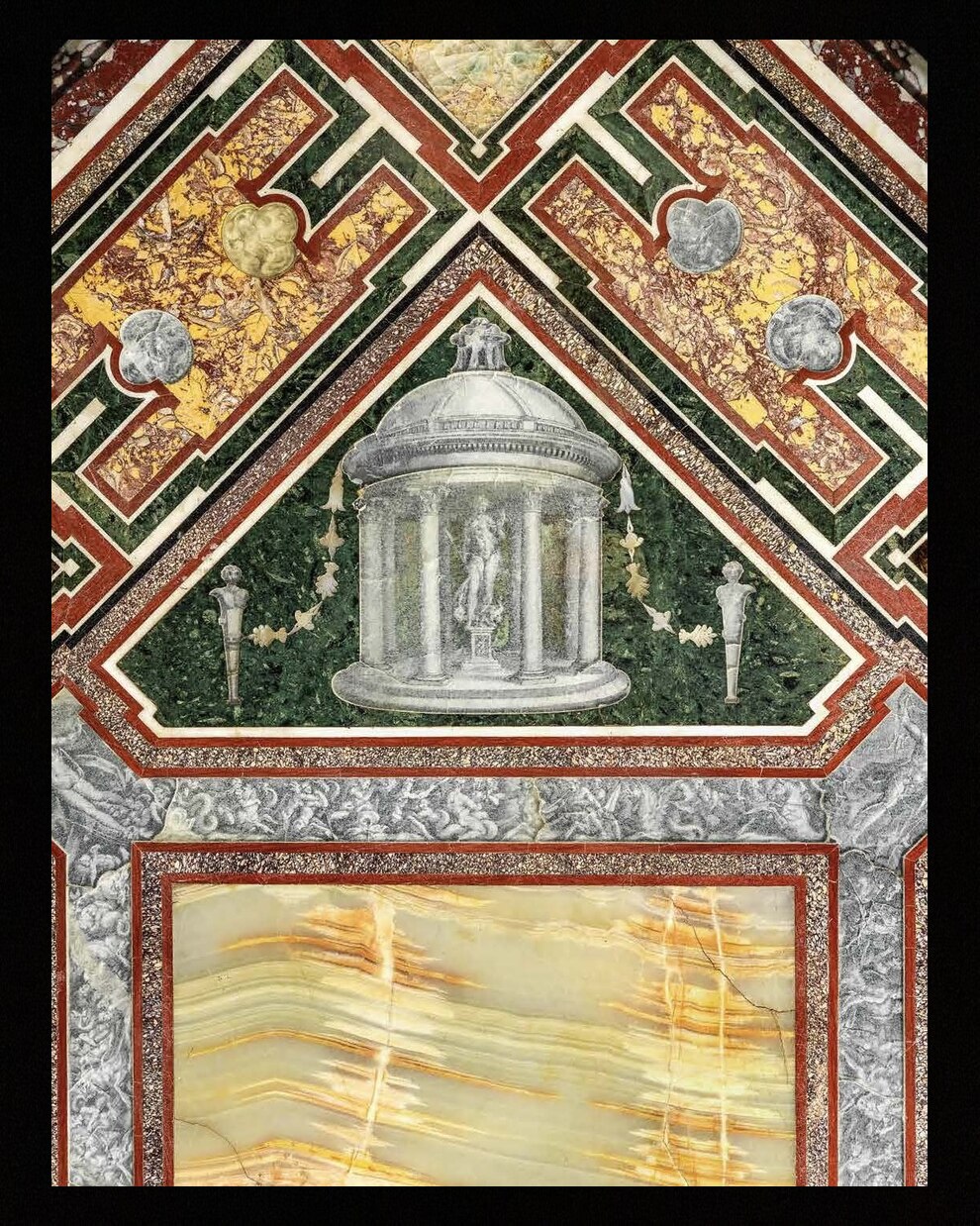
Casale worked for Ferdinando de’ Medici, and may also have known both Dosio and other individuals who were involved in this sort of marble work. We cannot place a clear timeframe around Casale’s presence in Rome, but it does seem to run from the late 1560s until the early 1570s, when we find him in Naples, before heading off to Spain and Portugal. In the holdings of the Biblioteca Nacional (National Library) of Spain in Madrid, there is a notebook with drawings collected by Casale, some in his own hand: one of these shows a detail of a table in pietre commesse (inlaid stones) and bears the names of the various types of marble. On another sheet, there are specifications of other stones such as breccia di Tivoli (also known as breccia Quintilina) and lapis lazuli, while on two occasions it is stated that the background was in verde antico and black, with measurements in palmi romani. The question remains as to whether these drawings are designs or records of tables seen, clearly in Rome.
The account below begins with a description of two anomalous masterpieces. We cannot classify them with any certainty as Roman: the first, designed and executed by Tuscans who were almost certainly in Rome, is on a wooden base; the second is perhaps the most spectacular of all tables in the Prado’s collection. Both are almost entirely decorated with semiprecious stones.
The Table of Bindo Altoviti
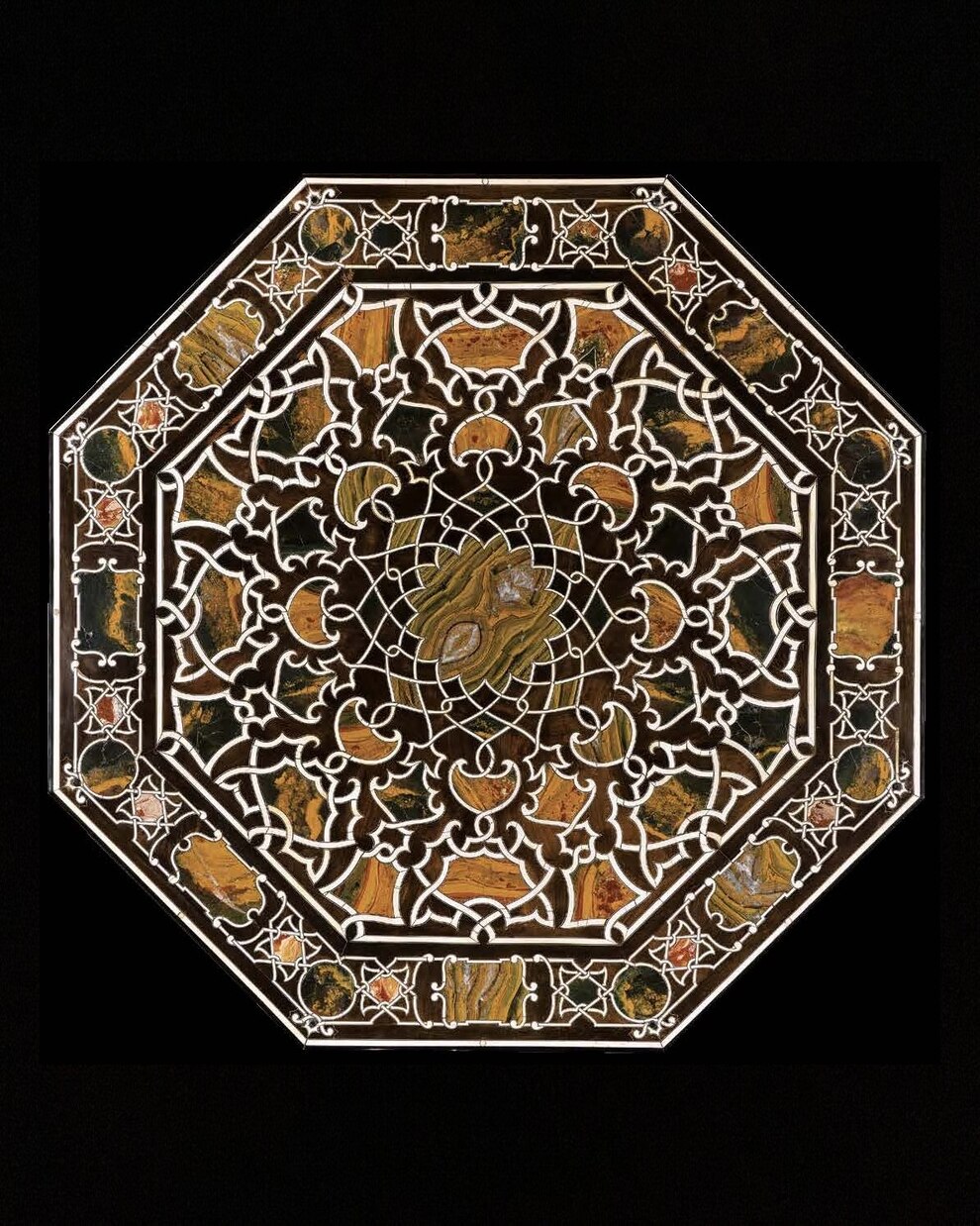
In the life of Bernardo Buontalenti, found in the 1568 edition of Vasari’s Lives, we read that Bernardino di Porfirio da Leccio, an artisan with expertise in the cutting of semiprecious stones, had created a tabletop for Duke Cosimo I with a background of Egyptian alabaster, commesso, or inlaid, with rare stones, of significant value. Bernardino, we also learn from Vasari, had made a table for Bindo Altoviti as well; it was octagonal and had a ground of ebony and ivory, inlaid with jasper. It was entirely based on a design by Vasari himself. Many years ago, I was able to identify Bindo Altoviti’s table, which matches Vasari’s description.
Bindo Altoviti (1491-1557), a great patron of the arts (a portrait of him as a young man by Raphael is now in Washington, D. C., and the magnificent bust of him as an old man now in Boston is by Cellini), was an exceedingly wealthy man in regular contact with the leading artists of the era. He was quite at home in Vasari’s company, as we can gather from a letter by Vasari himself, dating from 1553: “In the meantime I will look to spending healthy time with my very cordial Master Bindo to enjoy the pleasures that God has bestowed upon him, just as he enjoys these few virtues of mine and my conversation.” The small table depicted here must date from sometime prior to 1557 (when Bindo died). That Messer Bindo owned fine furniture made of ebony and ivory is confirmed by the gift of a tabletop in those two materials made by him to Pope Paul III and mentioned in accounting submitted by a French carpenter named Jacomo, who’d been assigned by the papal administration to build a supporting base for it.
The table appears in a 1591 inventory of Palazzo Altoviti in Rome: “A small table worked in stone and ebony and ivory with a walnut leg in the form of an octagon.” The table appears as an odd and whimsical creation of geometrically intertwined arabesques which, to all appearances, was far from Vasari’s taste. At any rate, we should recall that Leonardo da Vinci conceived similarly extravagant patterns in a series of engravings (Academia Leonardi Vinci, Milan 1483-1499), later made famous in copies by Albrecht Dürer (1507).
The Table of Philip II
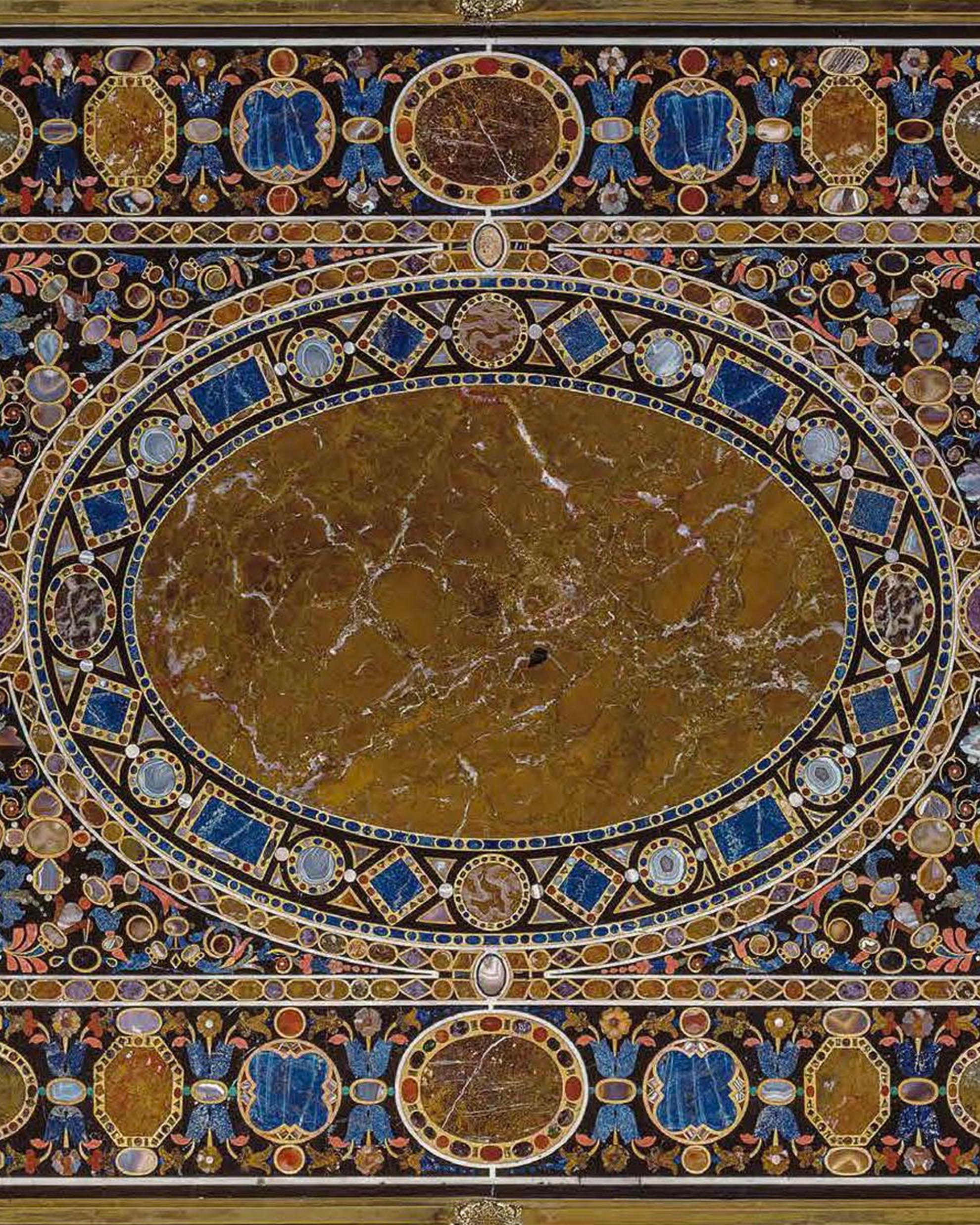
In the Museo del Prado, there is a table of exceptional quality, made entirely of semiprecious stones, which was given to Philip II by Cardinal Bonelli, familiarly known as Alessandrino, great-nephew of Pius V, who had received great favors from the Spanish king. The table is described in an application to export it from Rome: “A table, approximately thirteen palmi in length and six and a half palmi in width, with a base and edges of marmo statuario (statuary marble), framing and sections in marmo africano, and a mix of jewels, lapis lazuli, agate, carnelian, jasper, and other precious stones… which is being sent… by Cardinal Alessandrino from Rome to Spain.” The marble border described in that application was lost during one of the restorations to which the table was subjected over the centuries, and was replaced with one in bronze.
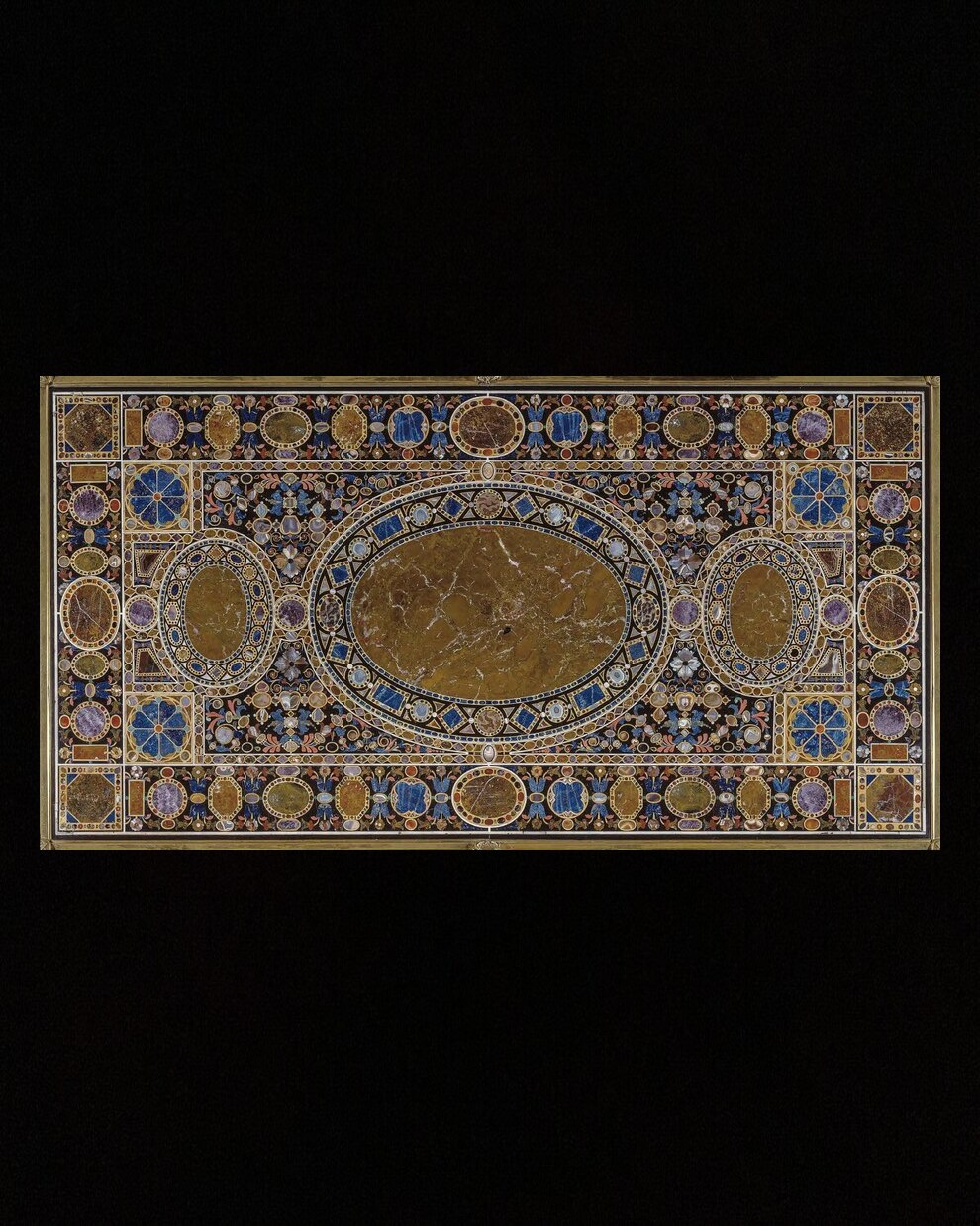
Cardinal Alessandrino’s gift was sent from Rome, but we cannot be equally certain that it was fabricated in Rome.
Almudena Pérez de Tudela has discovered, in her research, a number of references to the table that specify its provenance and oblige us to make corrections to its date of manufacture and especially the date of its export from Rome, as determined from a nineteenth-century publication by A. Bertolotti. In a letter dated May 30, 1584, the Spanish ambassador to Rome, the Count of Olivares, wrote to Philip II: “Cardinal Alessandrino has purchased a stone table, at Cardinal Delfino’s auction, in order to send it to Your Majesty, and he paid five thousand scudi for it, roughly equivalent to half the value of the stones alone. It took twenty years for Cardinal Delfino to have it made, and it’s not even finished now, and I doubt it will be finished in time to be loaded onto the galleys with which Marcantonio Colonna is coming. It’s a very beautiful piece of work, and it’s suitable for the royal apartment of Aranjuez.” An Avviso, or official report, dated 27 October of that same year, 1584, states that the table had departed, and other Spanish sources dated February 1585 confirm that the table had been shipped from Genoa. But the precious gift appears to have remained undelivered for a considerable period of time, in storage in the port of Alicante. It was not until 1587 that the king sent his thanks to the cardinal.
In order to emphasize just how extraordinary a gift it was, Cardinal Bonelli asked the antiquarian and scholar Vincenzo Stampa to compose a brief explanatory poem in Latin to send to the king, laying out the qualities and hidden meanings of the stones. In any case, the license for exportation of this artwork from Rome must not have been dated 1587 (as Bertolotti wrote), but 1585. Another correction concerning the table’s date of execution: as Olivares wrote in 1584, work on the table must have begun some twenty years earlier at the behest of the client, Cardinal Zaccaria Dolfin (1527-1583, cardinal from 1565 on).
The Farnese Table
Perhaps the most impressive piece of furniture built in Rome during the sixteenth century is the Farnese Table, which was rediscovered in England around 1950 by a very adept Roman antiques dealer, Carlo Sestieri. He found it in the possession of a London merchant who specialized in the sale of garden furnishings. The restoration was done in Rome, the only place where the appropriate techniques were known and the necessary stone material was available. The table was highly esteemed by Olga Raggio, a Roman-born scholar who spent her entire career at the Metropolitan Museum of Art in New York. The museum acquired the table in 1958 and she published the first article about it in 1960.
In the 1644 inventory of Palazzo Farnese, this is how the table was described: “A large table made of pietre tenere et dure, (soft and hard, or semiprecious stones), with the center made of alabastro orientale (Egyptian alabaster), three marble legs carved in the shape of harpies, and the coat of arms of His Eminence the Cardinal.” The last known document to mention the table as still being in the building for which it was made dates from 1796; it reappears fifty or so years later, in 1844, at Hamilton Palace in Scotland.
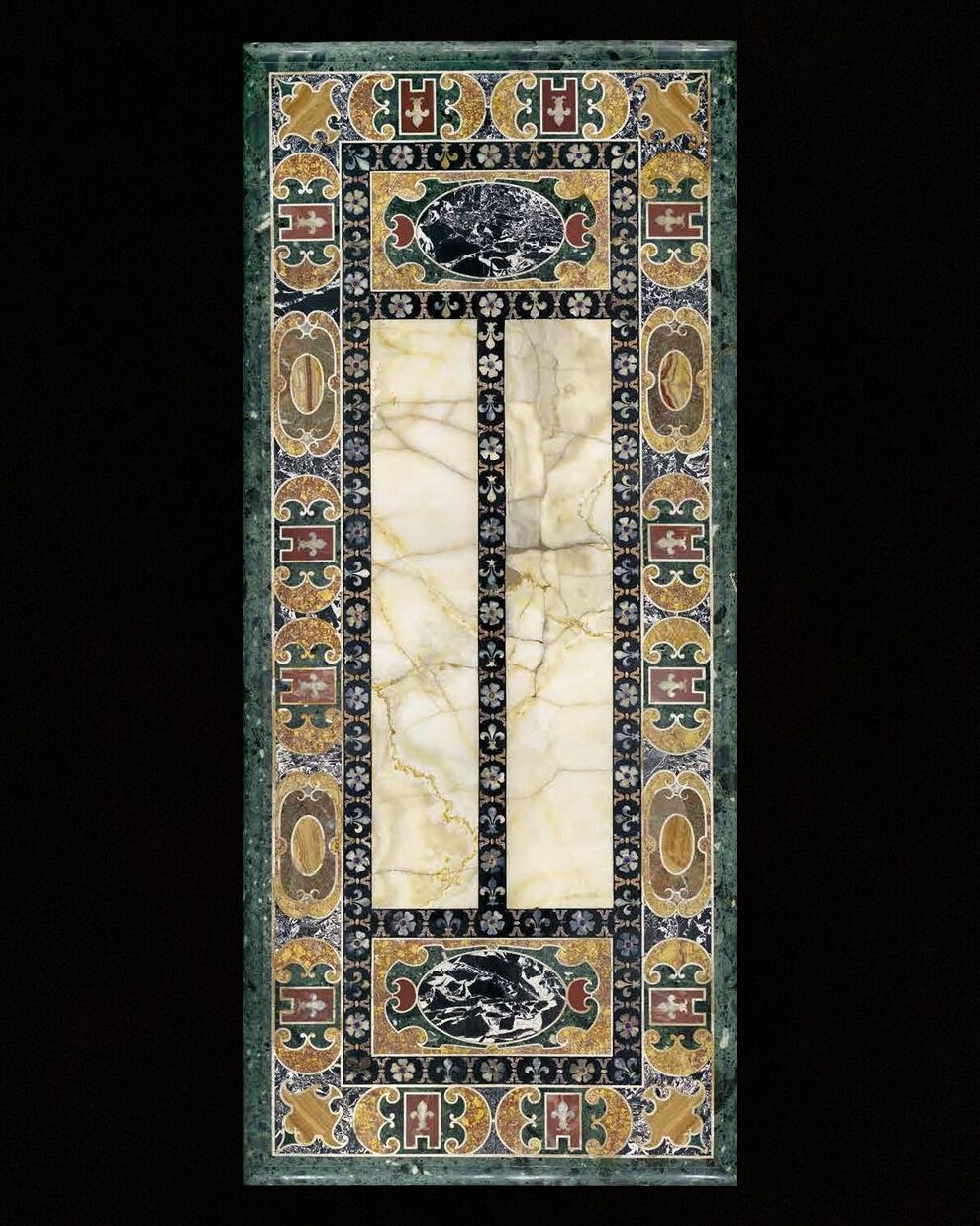
The table is built around two exceptional slabs of a very rare Egyptian alabaster, enclosed within borders of the lilies of the Farnese and the rosettes of the Orsini (the maternal family of cardinals Alessandro and Ranuccio Farnese). At either end are two ovals of bianco antico di Aquitania and nero antico di Aquitania on a ground of broccatello and other rare types of marble. A frieze composed of various classical elements with more heraldic lilies runs around it. The magnificent white marble base consists of three powerful sculptural elements, each depicting harpies and other bearded mythological beings with bat wings which support the heraldic crest of Cardinal Alessandro Farnese; what we do not see here, however, is the heraldic crest of Alessandro’s brother, Cardinal Ranuccio, who very much liked to see his own heraldic emblem pretty much everywhere around the palazzo, since he was the main family member to live there. (Pope Paul III of course lived in the Vatican, where he died in 1549, and Cardinal Alessandro lived in the Palazzo della Cancelleria.) Things changed however following Ranuccio’s death in 1565, which is what led Olga Raggio to suppose, in her 1960 article, that the table was made sometime after that year.
But a great deal of water has passed under the Tiber bridges since 1960: and there have been great advances in our knowledge, especially concerning the most renowned figure of the time working in marble intarsia, Jean Ménard, also known as Il Franciosino, whose historical profile I had begun to delineate in 1981. Research was continued by Filippo Tuena and Jean-Nérée Ronfort, while, more recently, Bertrand Jestaz linked Ménard to the Farnese Table based on the appearance of the Frenchman’s name in Cardinal Alessandro’s accounting for the year 1569. That suggestion strikes me as plausible, but I have a hard time accepting it as definitive. Later, Jestaz further strengthened his attribution on the basis of similarities between the Farnese Table’s border and the border of a table in the Casa de Pilatos in Seville, which was supposed to have belonged to the man who was Viceroy of Naples during the years that Ménard spent there. It is quite a challenge to attribute an artwork of this kind on the basis of similarities in ornamental motifs, given the fact that we still can’t state with any certainty whether artisans capable of making marble inlaid tables were also able to design them.
Cardinal Ferdinando: Tables Made in Rome for the Medici
Relations between the Medici family and the Holy See, as far as the history of objects made of colored marble and semiprecious stones is concerned, reach their high point in 1560 when Grand Duke Cosimo I travelled to Rome, accompanied by his first-born son Francesco. But it was primarily his second-born son, Ferdinando, who showed a deep and abiding interest in such items after becoming a cardinal (1563) and spending a substantial portion of each year in Rome, starting in 1569. He stayed in the Palazzo di Firenze, which had been bestowed upon Cosimo by Pope Pius IV. A series of payments, only unearthed in relatively recent years, document the fact that a small group of artisans had begun to work in that very same building, creating inlaid marble tables. According to a document from a later date (June 25, 1576), this work was carried out in a large room overlooking the courtyard of Palazzo di Firenze: the document mentions an array of materials placed “in the courtyard room where stones were shaped for the production of tables.” Those artisans were Giovanni Antonio Lillo, described as a “stone cutter,” Maestro Pietro Bastiano da Carona, also known as “Il Fiorentino,” and Maestro Bartolomeo di Niccolò da Settignano, a commettitore, or mosaicist, working on tables and expert in stone inlay – although he cannot have been alone in working in intarsia because in July 1569 there was already mention of intagliatori – “stone cutters and those who inlay tables.” As best we can tell, the work, which seems to have begun in April 1569, was still behind schedule in September of that same year, and the cardinal wrote from Poggio a Cajano (near Florence) to Rome, complaining about how slowly work was proceeding and, at the same time, expressing his admiration for the alabaster that belonged to the Cavalier Gaddi, a Florentine aristocrat interested in stonework, which he privately commissioned.
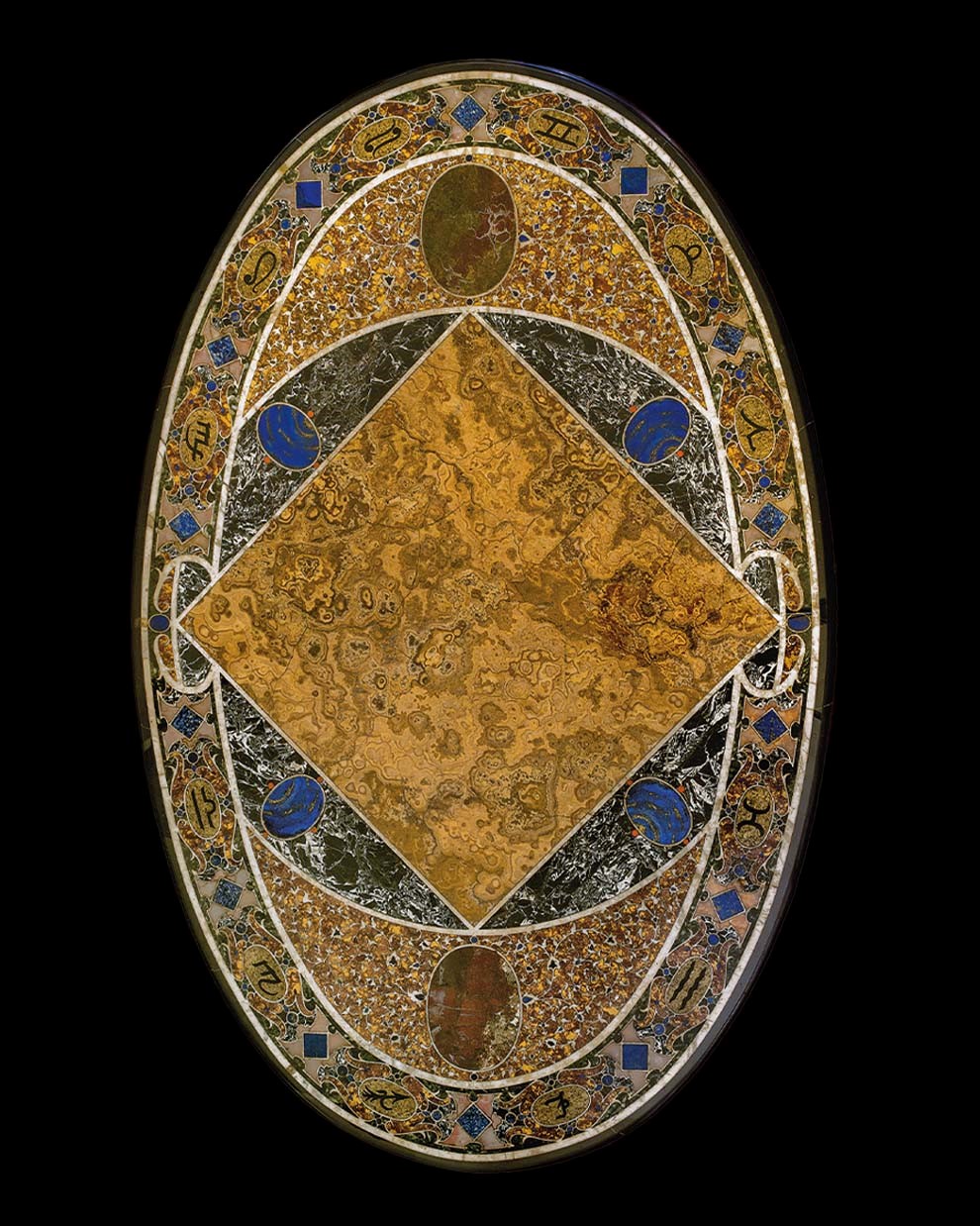
The Florentine collections contain at least two tables with commessi di pietre tenere (marble inlays) that are known to have come from Villa Medici in Rome, which was purchased by Ferdinando following the death of Cardinal Ricci in 1576; a third table certainly belonged to him during his years as a cardinal (from 1563 to 1588) since its wooden leg bears his heraldic crest surmounted by the galero, the flat-crowned wide-brimmed tasseled red hat worn by Roman Catholic cardinals. This third tabletop is oval shaped with a central square made of a rare variety of alabaster, which stands out not only against the slender white marble borders but also against the dark background of marmo d’Aquitania which in turn contains four lapis lazuli ovals. The larger ovate crescent shapes that mark the far ends of the ellipse in turn contain two larger oval shapes inserted against a background of broccatello di Spagna, embellished by delicate white marble volutes, a solution that, to the best of my knowledge, is unique in the history of stone inlay. The outer border contains the symbols of the zodiac in black marble against a background of lumachella, or “fire marble,” separated by intricate mixtilinear cartouches with lapis lazuli squares.
The very appearance of the table is an unmistakable manifestation of the passion that the Grand Duke Cosimo and both his sons felt toward astrology and other magical aspects of knowledge. The third table, now in Florence but originally from Rome, and the property of Ferdinando de’ Medici when he was a cardinal, presents two quite distinctive features: the “carte stampanti” or prints, covered by slabs of alabastro trasparente, and the garlands made of mother-of-pearl. What’s more, several of the stones used in the composition are particularly rare. The alabastro marino that forms the central square can also be found in a table that belonged to Cardinal Richelieu, now at the Louvre, as well as in the Rucellai Chapel in the Basilica of Sant’Andrea della Valle in Rome and in the main altar of the Basilica of Santa Cecilia in Trastevere; fluorite can be found in a table in Palazzo Pitti’s Sala di Venere (Hall of Venus); breccia di Tivoli, or Breccia Quintilina, is also a rare stone, and its discovery is usually dated from 1565; rarer still is the use of prints covered by alabastro trasparente, a technique found only on a few altars in Rome, such as in the chapel of Palazzo Altemps (after 1607).
The design of this table is among the most refined of late-sixteenth century Rome: it can only be compared to the design of the Farnese Table or the Zodiac Table. It not only shares with the latter table the refined and intellectual taste shown in its composition, but also the placement of the square central panel. In the table in question (where the central panel is conceived as a flat projection of the elevation of a room) it functions as an aqueous mirror meant to ideally reflect the marine figures and temples around its edges. In the table top with the zodiac, the square panel is cabalistically inscribed in a circle and surrounded by the symbols of the signs of the zodiac. Last of all, it should be pointed out that the “carte stampanti” mentioned in the 1588 inventory are almost certainly prints done in Rome after Raphael.
The Tables of the Duke of Lerma
To talk about the Duke of Lerma is tantamount to talking about the reign of Philip III: Don Francisco de Sandoval y Rojas, the Marquis of Denia and Duke of Lerma (1553-1625), was, as the poet Francisco de Quevedo tells us, a great gentleman among those that claimed family ties with illustrious and well-to-do forebears. Along with his titles, he also wielded power and Quevedo further describes him as a man who knew how to practice adulation, was more talented than wise, imperiously willful with others though possessed of no will power of his own, more of a squanderer than a generous man, impulsive rather than liberal, but, clever, in the end, because he gave away that which he received; sometimes he overdid things to such a degree that many had the impression that rather than being in the service of the king, he was competing with him. Once he sensed that his star was setting, Lerma, by then a widower, managed to persuade Pope Paul V to have him ordained a cardinal in 1618 (an ecclesiastical title that entailed the special immunity enjoyed by princes of the church).
Popular opinion rapidly excoriated that shrewd move: “Para no ser degollado | el mayor ladrón de España | se vistió de colorado” (to avoid the executioner’s ax, Spain’s greatest thief donned the crimson robe).
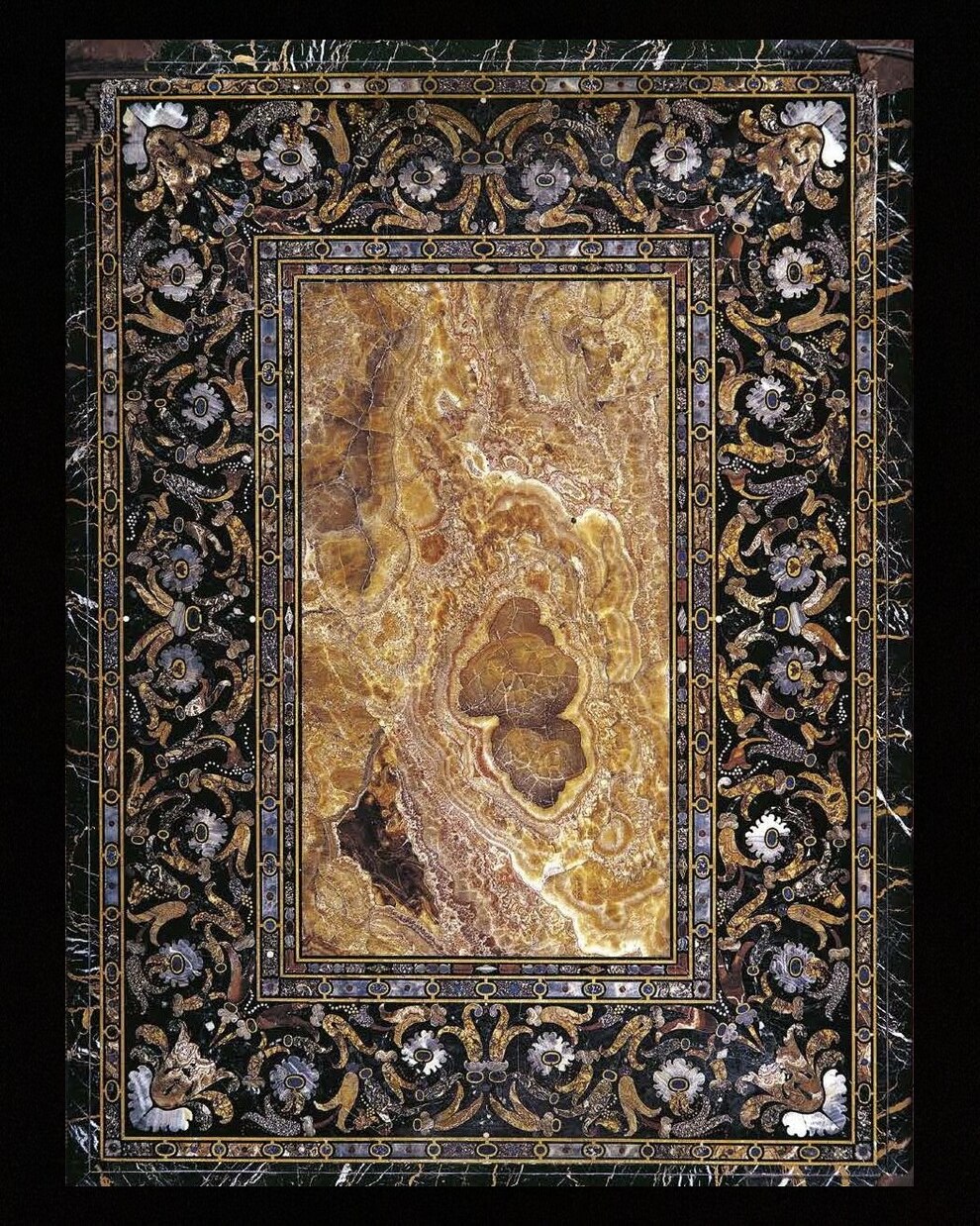
It has been possible to identify three tables that were property of the duke and were also reliably made in Rome. Two of them are now in the Colegiata de San Pedro de Lerma and they are remarkably fine pieces of work. The first table (130 x 190 cm) has at its center an oval of exceedingly rare alabastro marino surrounded by two collarini, and a noteworthy radial design, all on a ground of black marble with an intertwining motif of cartouches or scrollwork in broccatello di Spagna, surrounded by flower volutes and palmettes, against which we see a handsome array of marble from archeological digs, such as semesanto, lumachella, and verde antico; two thin borders of white marble isolate the broad border, where we see a procession of scrollwork in bianco antico and nero di Aquitania against a ground of broccatello, separated by lapis lazuli ovals with panoplies, or sets of armor.
The second Lerma Table, likewise rectangular (120 x 160 cm) features a large expanse of alabastro cotognino set in a double thin line with strips of alabastro trasparente studded with lapis lazuli and rosso antico; surrounding it is a band with broad volutes against a black ground featuring broccatello, semesanto, and other marble from archeological digs; a border with ovals and circles reminiscent of the innermost ones separates the whole composition from an ogee or s-shaped border in portoro (which is sadly damaged). These two table tops are now housed in the Upper Gallery of the Ducal Palace of Lerma, which occupies the rooms where Philip III stayed as the Duke’s guest. The third table that we are confident belonged to the Duke of Lerma, originally from Ventosilla and now in Valladolid’s Museo Nacional, is circular. Particularly close to the first of Lerma’s tables shown here, the one with an alabastro marino oval at its center, is a table mentioned in 1676 at the Château de Richelieu, and belonging either to the cardinal or his brother, as noted above.
.jpg)
The Table of Don Rodrigo Calderón
The table that we shall now examine belonged to a leading figure at the court of Philip III, Don Rodrigo Calderón (c. 1576-1621), a great favorite of the king’s own favorite, the Duke of Lerma. In his lifetime, he held prominent positions, married a woman of wealth, was ennobled with the title of Marqués (Marquis) of Siete Iglesias, and appointed commander of the king’s German guard. He was never much liked by the Spanish queen, Margaret of Austria, who initiated investigations into his behavior, but when she died in 1611, he was cleared of all suspicion.
His career continued as brightly as before, but following the Duke of Lerma’s disgrace in 1618, Don Rodrigo was left without protection from above and was arrested in February 1619 and charged with corruption and embezzlement. His star had already set by now, and the king’s unexpected death, on March 31, 1621, extinguished all hope. Six months later, his execution was ordered; the new king, Philip IV, displayed implicit trust in his minister, the Count-Duke of Olivares, and did not intervene. This is not the place for us to examine the personality of that greedy collector and politico, but we should recall that during his trial, which had taken place on September 4, 1620, he was tried on 240 counts. Of those counts, number 160 concerned the table in question. That detail allowed me to date the table, which had previously been misattributed as a gift from Pope Pius V to John of Austria.
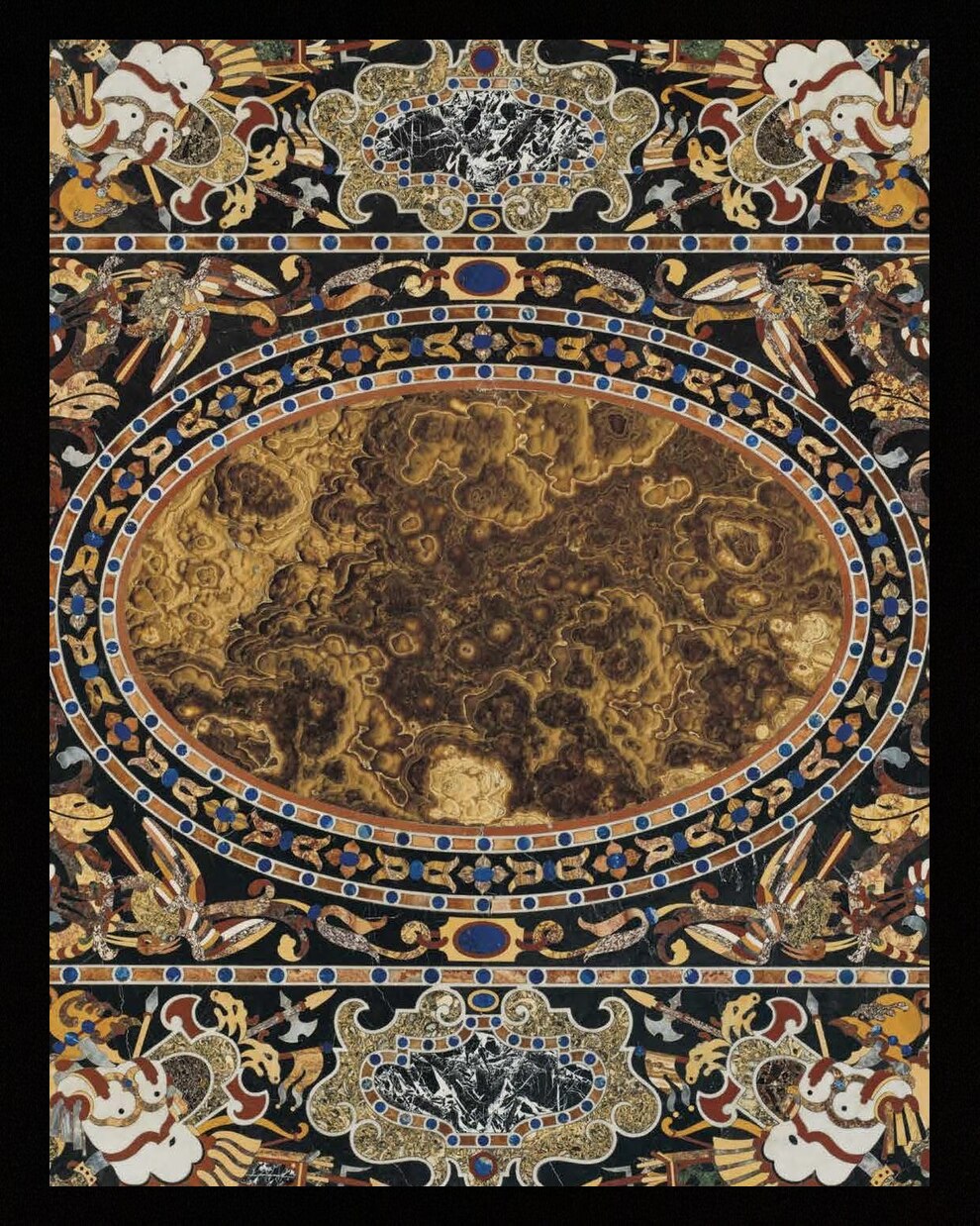
Count number 160 of 1620 in fact stated that “a man of the cloth had brought from Rome a table of jasper that, according to appraisal and taxation, was worth 12,000 ducats, as it was made of numerous jaspers and featured, among the other ornaments, several figures of Turks firing artillery. At its center there is a very large agate stone, seven-eighths of a vara in size; this table measures three varas and an eighth in width by a vara and a half plus a twelfth” (the Spanish word jaspe that appears means both jasper and colored marble). The measurements reported in that count amount to about 264 x 132 cm and match the size of the table now at the Prado. The document was wrong in claiming that the large alabastro tartarugato (tortoise shell alabaster) oval at the center was actually agate, but it did correctly describe the fundamental element of decoration, the figures of Turks, though they weren’t firing cannons, but were instead seated, hands bound, next to panoplies with cannons. Shortly thereafter, the table was ushered into the royal collections after the king paid the price demanded. The table begins to be mentioned once again in the 1636 inventory of the Alcázar, which gives its location and specifies that it had come from Don Rodrigo Calderón’s auction and that it had legs made of Toledo marble; this time, however, the large central oval is correctly identified as being made of a marble that only looked like agate. It seems clear that Don Rodrigo’s table was Roman in origin and that it belonged to a later period than the other tables considered thus far.
The decorative program is far richer and more intricate; what’s more, while some naturalistic details such as the weaponry and the panoplies may well be found in other works dating back to as early as the late sixteenth century, we find no other instances of the human figures shown here. There are other tables that seem closer to this lavish and serried type of composition, like one in Lisbon’s Museu Nacional de Arte Antiga, whose central part has a black ground with a complex decoration featuring plant motifs surrounding an alabaster oval.1 Leaving aside a few lapis lazuli elements and others in quartz, the Calderón Table is entirely made out of marble, that is, pietre tenere (soft stones); in the Florentine counterparts, even those table tops that are preponderantly made of marbles, the use of semiprecious stones is certainly more extensive. The unique presence of human figures in this composition suggests that it might have been a special commission, perhaps in connection with the Battle of Lepanto, which ended in the victory of the forces of Christendom, and – even though we have no other documentation other than the transcript of the trial mentioned above – it seems reasonable to suppose that work cannot have been completed for very long before it came into the possession of the Duke of Lerma’s favorite Calderón.
Alvar González-Palacios
translation by Laurel Saint Pierre, Antony Shugaar
The table that we shall now examine belonged to a leading figure at the court of Philip III, Don Rodrigo Calderón (c. 1576-1621), a great favorite of the king’s own favorite, the Duke of Lerma. In his lifetime, he held prominent positions, married a woman of wealth, was ennobled with the title of Marqués (Marquis) of Siete Iglesias, and appointed commander of the king’s German guard. He was never much liked by the Spanish queen, Margaret of Austria, who initiated investigations into his behavior, but when she died in 1611, he was cleared of all suspicion.
His career continued as brightly as before, but following the Duke of Lerma’s disgrace in 1618, Don Rodrigo was left without protection from above and was arrested in February 1619 and charged with corruption and embezzlement. His star had already set by now, and the king’s unexpected death, on March 31, 1621, extinguished all hope. Six months later, his execution was ordered; the new king, Philip IV, displayed implicit trust in his minister, the Count-Duke of Olivares, and did not intervene. This is not the place for us to examine the personality of that greedy collector and politico, but we should recall that during his trial, which had taken place on September 4, 1620, he was tried on 240 counts. Of those counts, number 160 concerned the table in question. That detail allowed me to date the table, which had previously been misattributed as a gift from Pope Pius V to John of Austria.
Count number 160 of 1620 in fact stated that “a man of the cloth had brought from Rome a table of jasper that, according to appraisal and taxation, was worth 12,000 ducats, as it was made of numerous jaspers and featured, among the other ornaments, several figures of Turks firing artillery. At its center there is a very large agate stone, seven-eighths of a vara in size; this table measures three varas and an eighth in width by a vara and a half plus a twelfth” (the Spanish word jaspe that appears means both jasper and colored marble). The measurements reported in that count amount to about 264 x 132 cm and match the size of the table now at the Prado. The document was wrong in claiming that the large alabastro tartarugato (tortoise shell alabaster) oval at the center was actually agate, but it did correctly describe the fundamental element of decoration, the figures of Turks, though they weren’t firing cannons, but were instead seated, hands bound, next to panoplies with cannons. Shortly thereafter, the table was ushered into the royal collections after the king paid the price demanded. The table begins to be mentioned once again in the 1636 inventory of the Alcázar, which gives its location and specifies that it had come from Don Rodrigo Calderón’s auction and that it had legs made of Toledo marble; this time, however, the large central oval is correctly identified as being made of a marble that only looked like agate. It seems clear that Don Rodrigo’s table was Roman in origin and that it belonged to a later period than the other tables considered thus far.
The decorative program is far richer and more intricate; what’s more, while some naturalistic details such as the weaponry and the panoplies may well be found in other works dating back to as early as the late sixteenth century, we find no other instances of the human figures shown here. There are other tables that seem closer to this lavish and serried type of composition, like one in Lisbon’s Museu Nacional de Arte Antiga, whose central part has a black ground with a complex decoration featuring plant motifs surrounding an alabaster oval.1 Leaving aside a few lapis lazuli elements and others in quartz, the Calderón Table is entirely made out of marble, that is, pietre tenere (soft stones); in the Florentine counterparts, even those table tops that are preponderantly made of marbles, the use of semiprecious stones is certainly more extensive. The unique presence of human figures in this composition suggests that it might have been a special commission, perhaps in connection with the Battle of Lepanto, which ended in the victory of the forces of Christendom, and – even though we have no other documentation other than the transcript of the trial mentioned above – it seems reasonable to suppose that work cannot have been completed for very long before it came into the possession of the Duke of Lerma’s favorite Calderón.
Alvar González-Palacios
translation by Laurel Saint Pierre, Antony Shugaar
Alvar González-Palacios is an art historian. Born in Santiago de Cuba, he is now an Italian citizen and lives in Rome. He has attended universities in Havana, Paris (the Sorbonne), and Florence, where he studied under Roberto Longhi. He took his degree with a thesis on courtly art at the University of Naples. González-Palacios is considered one of the leading historians of the decorative arts, with a special interest in Italy, France, and Spain, and has published extensively in that field. His latest book is Il mobile a Roma. Dal Rinascimento al Barocco (Ugo Bozzi 2022). In 1997, he was awarded the title of Officer of the French Order of the Legion of Honor.
NOTES
- Other tables that can be compared to the table in question are in the Galleria Borghese, the J. Paul Getty Museum, the Palazzo Ducale in Mantua, the Metropolitan Museum of Art in New York (not the Farnese Table), and in Charlecote Park in Warwickshire.


